I first heard about H4CBD from a friend who described it as “CBD with a little extra kick”—and honestly, that caught my attention. After years of using regular CBD for my evening wind-down routine, I was curious whether this newer cannabinoid could offer something different. What I discovered surprised me: H4CBD isn’t just a marketing gimmick, but a hydrogenated version of CBD that some users report produces noticeably stronger effects, including mild euphoria and deeper relaxation that traditional CBD rarely delivers.
If you’re reading this, you’re probably wondering the same thing I was: what exactly does H4CBD do, and how does it compare to the CBD you already know? The honest answer is that research is still catching up with availability. Unlike CBD, which has been studied extensively, H4CBD exists in a grey zone of limited scientific evidence and primarily anecdotal reports. Users describe effects ranging from enhanced calm and better sleep to subtle mood elevation—experiences that sound more potent than standard CBD but less intense than THC.
Here’s what makes this conversation complicated for Canadians: H4CBD occupies uncertain legal territory. While CBD itself is widely available and regulated, H4CBD’s chemical modification raises questions about how it fits within Health Canada’s frameworks. Throughout this article, I’ll share what we actually know about H4CBD’s effects based on current evidence, compare it honestly to regular CBD, address the safety concerns you should consider, and help you navigate the Canadian-specific legal landscape so you can make an informed decision about whether H4CBD deserves a place in your wellness routine.
What Exactly Is H4CBD?
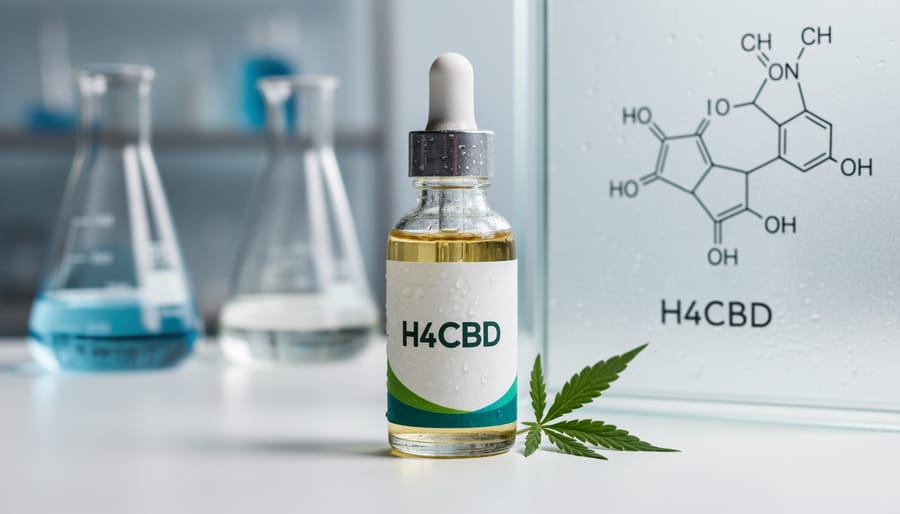
H4CBD, or hexahydrocannabidiol, is essentially CBD’s chemically modified cousin. If you’re familiar with regular CBD, think of H4CBD as a tweaked version created in a lab through a process called hydrogenation. This is the same technique used to turn vegetable oil into margarine—hydrogen atoms are added to the molecular structure, changing its properties.
The key difference between CBD and H4CBD lies in those extra hydrogen atoms. While CBD has a specific molecular arrangement, H4CBD has four additional hydrogen atoms attached, which is where the “H4” in its name comes from. This might sound complicated, but the practical takeaway is simple: this small change appears to make H4CBD interact differently with our body’s endocannabinoid system.
Why is H4CBD suddenly getting attention? Early anecdotal reports suggest it might be more potent than regular CBD, with some users claiming stronger effects for relaxation and discomfort management. It’s important to note, though, that we’re still in the early days of understanding this cannabinoid. Unlike CBD, which has been studied extensively, H4CBD research is quite limited.
The production process involves taking regular CBD extracted from hemp and putting it through hydrogenation in a controlled laboratory setting. Because it’s created through chemical modification rather than extracted directly from the cannabis plant, H4CBD is classified as a semi-synthetic cannabinoid.
Now, here’s where things get a bit murky for us Canadians. H4CBD exists in a regulatory grey area. It’s not explicitly illegal, but it’s also not clearly approved for sale. Health Canada hasn’t issued specific guidance on semi-synthetic cannabinoids like H4CBD, which means the legal landscape is uncertain. Some retailers are selling it, banking on the fact that it’s derived from legal hemp-based CBD, but there’s no guarantee this interpretation will hold up as regulations evolve. If you’re considering H4CBD, understand that you’re navigating uncharted regulatory territory.
How H4CBD Effects Actually Feel (Real User Experiences)
The Potency Question: Is H4CBD Really Stronger?
You’ve probably seen the bold claims online: H4CBD is 100 times more potent than regular CBD. As someone who’s spent years reviewing cannabinoid products, I can tell you that this number should be taken with a significant grain of salt.
Here’s what’s actually happening. This “100x stronger” claim originates from a single study examining how H4CBD binds to CB1 receptors in the brain compared to CBD. The research found that H4CBD showed greater affinity for these receptors in laboratory conditions. But here’s the crucial part: binding affinity in a test tube doesn’t directly translate to what you’ll experience when you take a product.
Think of it this way. Just because a key fits more snugly into a lock doesn’t mean it will unlock a door 100 times faster or better. The relationship between receptor binding and actual effects in your body is far more complex than a simple multiplication factor.
What users actually report is more modest. Most people describe H4CBD as noticeably stronger than CBD, yes, but certainly not 100 times more intense. The effects tend to be slightly more pronounced, with enhanced relaxation and potentially quicker onset times. Some Canadians I’ve spoken with mention feeling more noticeable calming effects compared to their regular CBD routine, but we’re talking about degree differences, not an entirely different experience.
The reality is we need much more human research before making definitive potency claims. Until then, approach those eye-catching numbers with healthy skepticism and focus instead on your own personal response.
Physical Effects People Notice
Most people who’ve tried H4CBD describe a notably calming physical sensation that settles throughout the body. From what I’ve gathered talking to users and reading through countless reviews, the most common experience is a gentle wave of relaxation that starts within 30-45 minutes and can last several hours.
Sleep seems to be where H4CBD really shines for many Canadians. Several people have told me they take it about an hour before bed and notice they fall asleep more easily and wake up less during the night. Some combine it with CBD and melatonin for enhanced sleep support, though I’d recommend starting with H4CBD alone first to see how your body responds.
Personally, I noticed a subtle but definite difference in muscle tension. After a long day at my desk, I felt less of that tight, wound-up feeling in my shoulders and neck. It wasn’t dramatic like taking a muscle relaxant, but more like the relief you’d get from a good stretch or warm bath.
Some users mention reduced physical discomfort, though experiences vary widely. A few people report feeling slightly drowsy at higher doses, while others notice improved focus alongside the physical relaxation. Everyone’s body chemistry is different, which is why starting low and going slow is so important.
Mental and Emotional Effects
One of the most common questions I hear from readers is whether H4CBD produces any psychoactive effects. Based on current user reports and limited research, H4CBD appears to offer mental clarity and calmness without the intoxicating sensation associated with THC. This is an important distinction, especially for Canadians familiar with CBD versus THC.
Users typically describe H4CBD’s mental effects as subtle yet noticeable. Many report experiencing a sense of relaxation and reduced mental chatter without impairment. Some individuals mention improved focus and concentration, making it potentially useful for daytime use. Mood enhancement is another frequently mentioned benefit, with users describing a gentle uplift in overall emotional wellbeing.
Unlike THC, H4CBD should not make you feel high. However, because it may interact more readily with CB1 receptors than regular CBD, some individuals report slightly more pronounced calming sensations. This doesn’t mean impairment, but rather a more perceptible sense of ease.
It’s important to note that individual responses vary considerably. Factors like dosage, personal biochemistry, and product quality all influence how you might experience H4CBD mentally and emotionally. Starting with lower doses helps you understand your personal response without overwhelming effects.
H4CBD vs Regular CBD: The Key Differences That Matter
When I first started comparing different cannabinoids, I assumed they’d all feel fairly similar. H4CBD taught me otherwise. While it shares CBD’s calming foundation, the differences between these two compounds matter more than you might think.
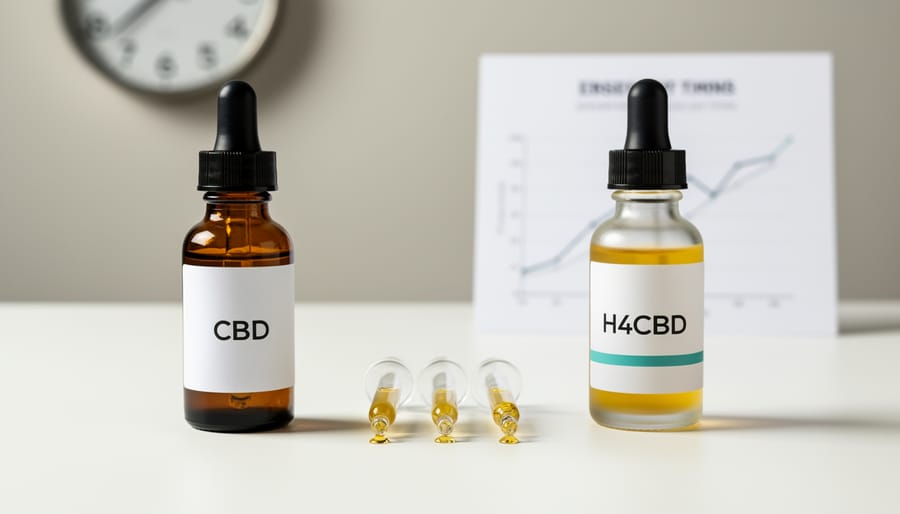
The most noticeable difference? Onset time and intensity. Regular CBD typically takes 30-60 minutes to kick in when taken orally, with effects building gradually. H4CBD, in my experience and according to user reports, tends to work slightly faster and with noticeably more presence. You don’t just wonder if it’s working—you know.
Duration-wise, both compounds offer fairly similar timeframes, with effects lasting anywhere from 4-8 hours depending on dosage and method of consumption. However, H4CBD’s effects tend to feel more pronounced throughout that window, rather than the gentler backdrop that traditional CBD provides.
Here’s where it gets technical, but stay with me. The key difference lies in how these molecules interact with your endocannabinoid system. Regular CBD has relatively weak affinity for CB1 receptors (the ones concentrated in your brain and nervous system). H4CBD, thanks to that extra hydrogen atom, binds more effectively to these same receptors. Think of it like a key fitting more snugly into a lock—it doesn’t change the lock, but it opens the door more efficiently.
This doesn’t make H4CBD intoxicating like THC, but it does explain why users report clearer, more tangible effects. Regular CBD works beautifully for daily wellness maintenance and gentle support. H4CBD seems better suited for situations requiring more noticeable relief—those days when regular CBD just isn’t cutting through.
From a practical standpoint, I’d suggest starting with traditional CBD if you’re new to cannabinoids. It’s more thoroughly researched, widely available across Canada, and offers a gentler introduction. Once you understand how your body responds to CBD, H4CBD becomes an interesting next step for situations demanding stronger support.
Cost is another consideration. H4CBD typically runs higher in price due to more complex production processes. For everyday use, regular CBD remains the economical choice. Reserve H4CBD for when you truly need that extra effectiveness—it’s the difference between your daily multivitamin and targeted supplementation.
What We Know (and Don’t Know) About H4CBD Safety
Let me be honest with you—the research on H4CBD safety is still in its early stages, and we simply don’t have the comprehensive long-term studies that exist for CBD or THC. This is something I think about a lot when people ask me whether they should try it.
What we do have are some promising animal studies suggesting that H4CBD doesn’t appear to cause significant toxicity at reasonable doses. Researchers have observed that it interacts with the endocannabinoid system differently than CBD, potentially binding more directly to CB1 receptors, but these studies are limited in scope and duration. We’re essentially working with preliminary data rather than decades of clinical trials.
User reports have been mostly positive, with side effects similar to what people experience with regular CBD—occasional dry mouth, fatigue, or mild digestive discomfort. Some users have mentioned feeling slightly more sedated with H4CBD compared to CBD, which makes sense given its potentially stronger receptor binding. I haven’t personally experienced any concerning side effects, but I’m also careful about dosing.
Here’s where caution becomes especially important: we don’t know how H4CBD affects pregnant or breastfeeding individuals, people with liver conditions, or those taking multiple medications. The same precautions that apply to CBD should apply here, but with an extra layer of carefulness given the limited research.
If you’re someone who’s been using CBD for a while and understands how your body responds to cannabinoids, you might be better positioned to try H4CBD than a complete beginner. But regardless of your experience level, starting with a very low dose—think 5-10mg—is essential. You can always increase gradually, and this approach helps you avoid developing CBD tolerance while letting you assess how your body responds.
The bottom line? H4CBD shows promise, but treating it with respect and caution is the smartest approach until we have more definitive safety data.
Finding and Using H4CBD Products in Canada
Finding H4CBD products in Canada requires a bit more effort than picking up regular CBD, since this cannabinoid is still relatively new to the market. Currently, H4CBD isn’t widely available in mainstream retailers or pharmacies across Canada. Your best bet is to look for specialized online cannabis and hemp retailers that focus on novel cannabinoids and carry a diverse product range beyond standard CBD offerings.
When shopping for H4CBD, you’ll most commonly find it in tincture or oil form, similar to traditional CBD products. Some retailers also offer H4CBD vape cartridges, though these are less common. Edibles and topicals containing H4CBD are rare at this point, but availability is gradually expanding as demand grows.
For beginners, I’d recommend starting with a tincture because it allows for precise dosing and flexibility. Begin with a low dose—around 5-10mg—and observe how your body responds over several days before increasing. This cautious approach mirrors the guidance you’d follow when learning how much CBD to take, though H4CBD may produce more noticeable effects at lower doses due to its potentially enhanced binding affinity.
Quality and safety should be your top priorities when purchasing H4CBD. Look for products with third-party lab testing certificates (COAs) that confirm cannabinoid content and verify the absence of contaminants like heavy metals, pesticides, and residual solvents. Reputable vendors will make these test results readily available on their websites.
Be cautious of unrealistic claims or suspiciously cheap products. Since H4CBD is produced through chemical modification of CBD, the manufacturing process matters significantly. Stick with established Canadian retailers who are transparent about their sourcing and production methods, even if it means paying slightly more for peace of mind.
Should You Try H4CBD? My Honest Take
Here’s my honest take: H4CBD isn’t for everyone, and that’s perfectly okay.
If you’re already happy with traditional CBD and it’s meeting your wellness needs, there’s really no pressing reason to switch. CBD has decades of research behind it, predictable effects, and is widely available at various price points across Canada. Why fix what isn’t broken?
That said, I think H4CBD might be worth exploring if you’ve found regular CBD underwhelming or if you’re specifically looking for something with potentially stronger effects for physical discomfort. When I first tried it, I’d been using CBD for about two years and felt ready to experiment with something new. Being an experienced cannabinoid user definitely helped me feel confident navigating unfamiliar territory.
Budget matters too. H4CBD products typically cost more than comparable CBD items, so factor that into your decision.
My biggest piece of advice? If you’re new to cannabinoids altogether, start with traditional CBD first. Get comfortable with how your body responds to cannabinoids in general. Once you have that baseline understanding, you’ll be better equipped to notice differences if you eventually try H4CBD.
And remember, there’s no rush. H4CBD will still be here when you’re ready, if you ever are. Trust your gut and move at your own pace.