
Navigate Canada’s CBD landscape by understanding that while CBD legality in Canada exists federally, your province or territory determines what you can actually buy, where you can purchase it, and how much you’re allowed to possess. Federal law permits CBD products containing up to 0.3% THC, but provincial regulations control everything from retail locations to age restrictions and public consumption rules.
Check your provincial cannabis retailer’s website first—this is your most reliable source for current possession limits, approved purchase locations, and whether online ordering is available in your area. Each province operates differently: some allow private retailers while others maintain government-only stores, and these distinctions directly impact your access to CBD products.
Verify product labeling before purchasing. Legal CBD products must display a standardized cannabis symbol, THC/CBD content, lot numbers, and health warnings. If these elements are missing, the product isn’t compliant with Canadian regulations regardless of where you’re buying it.
Understand that crossing provincial borders with CBD follows the same rules as cannabis—you can travel within Canada with legally purchased products up to the federal possession limit, but regulations about where you can consume them change the moment you enter a different province. What’s permitted in your backyard at home might be prohibited in a public park one province over, making location-specific knowledge essential for staying compliant wherever you are in Canada.
How Federal and Provincial CBD Laws Work Together (And Why It Matters)
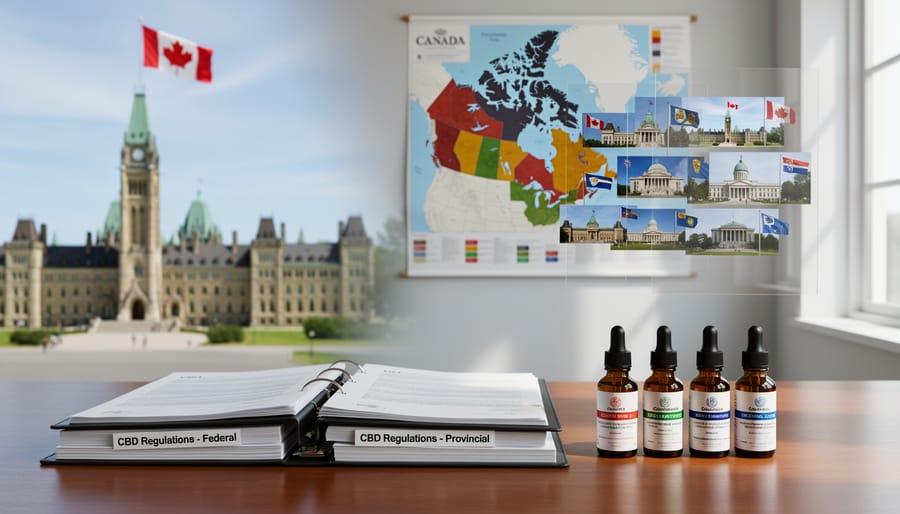
Understanding CBD laws in Canada means wrapping your head around a two-tier system that can initially feel confusing. Here’s the basic framework: the federal Cannabis Act sets the national rules for cannabis and CBD, while each province and territory gets to add its own layer of regulations on top.
Think of it like building codes for houses. The federal government establishes the baseline safety standards that apply everywhere in Canada, covering things like production standards, product testing requirements, THC limits, packaging rules, and how CBD products can be advertised. These rules don’t change whether you’re in Vancouver or Halifax.
But here’s where it gets interesting. Provinces and territories have authority over several key areas that directly affect your day-to-day experience with CBD. They decide the minimum age for purchasing CBD products, which ranges from 18 to 19 depending on where you live. They control how and where CBD can be sold, which is why you’ll find different retail models across the country. Some provinces allow private stores, others maintain government-run shops, and the rules about whether CBD can be sold alongside regular cannabis vary too.
Provinces also set rules about possession limits beyond your home, designate where you can consume CBD products, and establish penalties for violations. This is why you might legally do something in Ontario that could get you fined in Quebec.
When I first started exploring CBD, I assumed federal legalization meant uniform rules everywhere. I quickly learned that’s not the case. This dual system exists because Canada’s constitution gives provinces control over property, civil rights, and local matters. It’s not designed to confuse you, it’s just how Canadian governance works. Understanding this structure helps explain why checking your specific province’s regulations is essential before purchasing or using CBD products.
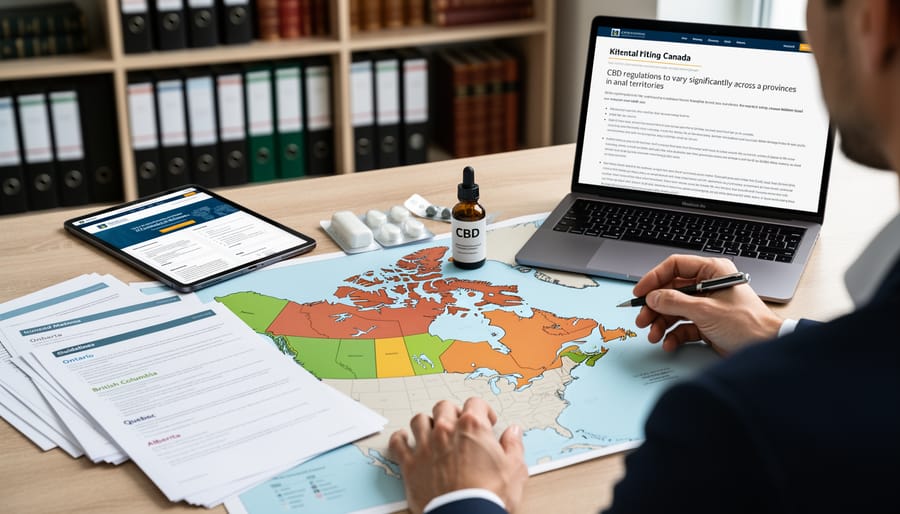
Province-by-Province CBD Rules: What’s Legal Where You Live
Western Canada: BC, Alberta, Saskatchewan, and Manitoba
Western Canada maintains fairly consistent CBD regulations across its provinces, though some notable differences exist in retail models and specific restrictions. If you’re planning to purchase or use CBD products in BC, Alberta, Saskatchewan, or Manitoba, here’s what you need to know.
In British Columbia, you must be 19 or older to purchase CBD products. The province operates a mixed retail model where both government-run BC Cannabis Stores and licensed private retailers sell CBD. You can possess up to 30 grams of dried cannabis (or equivalent) in public, and consumption is prohibited in vehicles, workplaces, and areas where smoking tobacco is banned. For more detailed information, check out BC’s specific regulations.
Alberta also sets the legal age at 19, though it was briefly 18 when legalization first began. The province features a fully privatized retail system, meaning you’ll purchase CBD from licensed private stores rather than government-run outlets. Possession limits mirror federal standards at 30 grams in public, and consumption restrictions prohibit use in vehicles, near schools and playgrounds, and in most public spaces.
Saskatchewan maintains a minimum age of 19 and operates a mixed retail model similar to BC, with both government-operated Saskatchewan Liquor and Gaming Authority stores and private retailers. The province allows consumption in private residences and designated areas, but restricts use in vehicles and public spaces frequented by minors.
Manitoba requires purchasers to be 19 or older and exclusively uses private retail stores for CBD sales. The province enforces some of Canada’s strictest consumption laws, prohibiting use in all public spaces, vehicles, and within prescribed distances of schools and recreational facilities.
All four provinces align with federal possession limits and require CBD products to be purchased from legal, licensed retailers to ensure quality and compliance.
Central Canada: Ontario and Quebec
Ontario and Quebec are home to more than half of Canada’s population, and while both provinces follow federal cannabis laws, they’ve each developed distinct approaches to retail and consumption that directly affect how you can access and use CBD products.
In Ontario, the provincial government chose a private retail model after initially attempting a government-run system. This means you’ll find licensed cannabis stores operated by private businesses throughout the province, giving you plenty of options for purchasing CBD products in person. Online sales are handled through the Ontario Cannabis Store (OCS), the province’s official online retailer. When I first started exploring CBD options in Ontario, I appreciated how accessible the products were, with stores clearly displaying their licensing and staff generally knowledgeable about different CBD formulations.
Quebec takes a more controlled approach through its government-operated Société québécoise du cannabis (SQDC) network. All legal cannabis and CBD sales must go through SQDC retail locations or their online platform. What sets Quebec apart are its notably stricter regulations around certain product types. The province has banned cannabis-infused edibles like gummies, chocolates, and baked goods, though CBD oils, capsules, and beverages remain available. This restriction surprised many when it was implemented, as edibles are legal under federal law and available in other provinces.
Both provinces restrict public consumption, though the specifics vary. In Ontario, you generally cannot consume cannabis or CBD products anywhere tobacco smoking is prohibited, plus additional restricted areas like vehicles and workplaces. Quebec similarly prohibits consumption in most public spaces, with designated areas being quite limited.
For residents of either province, purchasing from licensed retailers—whether physical stores or official online platforms—remains the safest way to ensure product quality and legal compliance. If you’re visiting from another province, remember that what’s acceptable back home might differ here, particularly regarding edibles in Quebec.
Atlantic Canada: New Brunswick, Nova Scotia, PEI, and Newfoundland and Labrador
The Atlantic provinces share several similarities in their CBD regulations, though each has implemented its own approach to retail and distribution. If you’re living in or visiting this region, here’s what you need to know about purchasing and using CBD products legally.
In New Brunswick, CBD products are sold exclusively through Cannabis NB, the province’s government-operated cannabis retailer, both in physical stores and online. You must be 19 or older to purchase CBD here. Private retailers aren’t permitted to sell cannabis or CBD products, which means your options are more centralized compared to some other provinces. The advantage? Consistent quality standards and guaranteed legal compliance across all purchases.
Nova Scotia takes a hybrid approach. The Nova Scotia Liquor Corporation operates cannabis stores, but the province also licenses private retailers to sell CBD and cannabis products. You’ll need to be 19 years old, and you can shop at NSLC Cannabis stores or approved private shops throughout the province. This gives residents more convenient access points, particularly in smaller communities.
Prince Edward Island operates similarly to New Brunswick with a government-run model. Cannabis PEI manages all legal CBD sales through its retail locations and online platform. The minimum age is 19, and all products meet federally regulated standards. The island’s smaller size means fewer retail locations, but online ordering with home delivery provides good accessibility.
Newfoundland and Labrador follows a private retail model with licensed stores operating across the province. At 19, you can purchase CBD from any licensed cannabis retailer, and the province has been relatively progressive in approving retail licenses. This has resulted in better retail coverage, especially considering the province’s geography.
All four Atlantic provinces prohibit selling CBD products in locations that also sell tobacco, and none allow CBD-infused foods sold outside the regulated cannabis retail system. When I spoke with retailers across the region, they emphasized that edibles, oils, and topicals all require the same retail channel as other cannabis products—there’s no separate “CBD-only” shop category in Atlantic Canada.
Northern Territories: Yukon, Northwest Territories, and Nunavut
Canada’s three territories—Yukon, Northwest Territories, and Nunavut—follow the same federal Cannabis Act that governs the rest of the country, meaning CBD products must contain less than 0.3% THC and be purchased from licensed retailers. However, the realities of accessing and using CBD in these remote regions come with some unique considerations you won’t find elsewhere in Canada.
Each territory operates its own cannabis retail system. In Yukon, you’ll find government-run Cannabis Yukon stores in Whitehorse, Watson Lake, and Dawson City, along with licensed private retailers. The Northwest Territories has a mixed model with both government and private stores, though availability is concentrated in larger communities like Yellowknife. Nunavut took a different approach initially, allowing only online sales through a territorial website, though this continues to evolve.
The biggest challenge in northern territories isn’t the laws themselves—it’s practical access. If you live in a smaller community without a local retailer, you’ll need to order online and wait for shipping, which can take considerably longer than in southern Canada. Weather delays are common, and shipping costs can be higher.
Indigenous governance adds another layer to consider. Many First Nations and Inuit communities have their own regulations regarding cannabis, including CBD, on their lands. Some communities have opted out of cannabis sales entirely, while others have specific bylaws. It’s essential to respect these local rules, which may be more restrictive than territorial legislation.
From my conversations with northern CBD users, I’ve learned that building relationships with local retailers and understanding community attitudes makes a real difference. One Yukon resident told me she always checks with her community wellness centre before trying new CBD products, appreciating the culturally informed guidance.
If you’re visiting or moving to a northern territory, research the specific community’s stance on cannabis before you travel. What’s legal territorially may not be welcomed locally, and respecting indigenous self-governance is both legally important and the right thing to do.
The Big Questions: Age Limits, Where to Buy, and How Much You Can Carry
When I first started exploring CBD in Canada, I remember standing in a store wondering if I needed ID, how much I could legally buy, and whether I could take it with me on a trip to visit family in another province. These practical questions matter just as much as understanding the broader legal framework, so let’s tackle them head-on.
First, the age question. In Canada, you must be at least 18 or 19 years old to purchase CBD products, depending on your province. The minimum age aligns with each province’s cannabis regulations: it’s 18 in Alberta and Quebec, while most other provinces require you to be 19. Always bring valid government-issued ID when purchasing CBD, whether you’re shopping in person or online. Retailers are legally required to verify your age, and honestly, it’s reassuring to see them taking this seriously.
Where can you actually buy CBD? You have several options. Licensed cannabis retailers offer CBD products both in physical stores and through authorized online platforms. Each province operates differently—some have government-run stores, others allow private retailers, and many offer a mix of both. You can also find CBD products in some health stores and pharmacies, particularly those derived from hemp with minimal THC content. When buying online, stick with licensed retailers that clearly display their authorization. I’ve learned that reputable sellers will always provide lab testing results and comply with Health Canada’s packaging requirements.
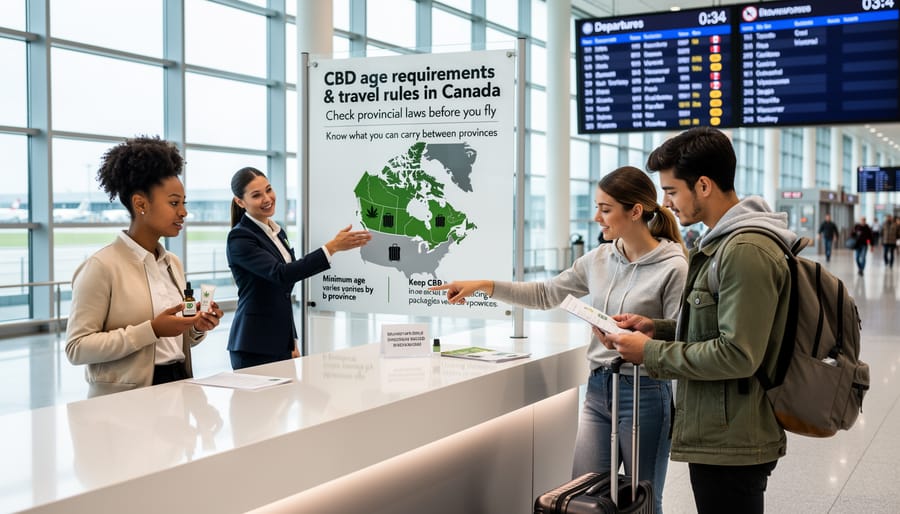
Now, about travelling with your CBD within Canada. The good news is that you can transport CBD products between provinces without issue, as long as you’re complying with federal possession limits. For adults, you can carry up to 30 grams of dried cannabis or its equivalent in CBD products for personal use. This applies whether you’re driving across provincial borders or flying domestically. Just keep products in their original, properly labeled packaging—it makes things smoother if you’re ever asked questions.
One thing that surprised me early on: there aren’t specific “purchase limits” per transaction in most provinces, but the 30-gram possession limit for public spaces still applies. You can buy more to keep at home, but be mindful of what you’re carrying around with you.
CBD Products That Have Different Rules Depending Where You Live
While CBD is federally legal across Canada, the product type you’re interested in might have different rules depending on which province you call home. Understanding these variations is crucial before you make a purchase or travel with your CBD products.
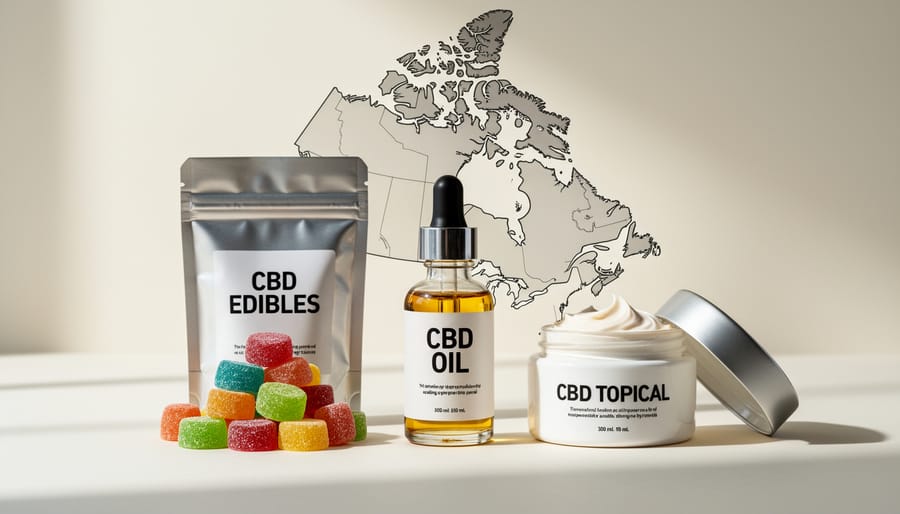
Edibles represent one of the most regulated categories. Federally, CBD edibles are limited to 10mg of total cannabinoids per package, but some provinces add their own restrictions. Quebec, for instance, prohibits the sale of all cannabis edibles entirely, which means CBD gummies and similar products aren’t available through legal channels there. Manitoba previously had similar restrictions but has since relaxed them. When I first started exploring CBD edibles, I was surprised to learn that the same product available in Ontario might be completely off-limits just across the provincial border.
Topicals like creams, balms, and lotions tend to have more consistent regulations across provinces, though packaging requirements can differ. Most provinces follow federal guidelines requiring child-resistant packaging and plain labeling, but you’ll notice variations in what information must be displayed prominently.
Vapes and inhalable CBD products face stricter scrutiny in several provinces. British Columbia and Ontario have implemented additional vaping regulations that affect CBD vape products, including flavor restrictions and where they can be displayed in stores. Some retailers in these provinces have limited selections compared to others.
CBD beverages are relatively new to the Canadian market and face similar dosage limitations as edibles. Alberta and Saskatchewan generally have more retailers carrying these products, while availability remains limited in Atlantic provinces.
Similar to Delta 8 legality, these product-specific rules can change, so checking your provincial cannabis authority’s website before purchasing ensures you’re staying compliant with current local regulations.
What Happens If You Break the Rules (Even Accidentally)
Most violations of provincial CBD laws happen unintentionally, and the good news is that consequences for minor infractions are typically reasonable rather than severe.
If you’re caught with CBD products that don’t meet your province’s requirements—perhaps they contain too much THC or lack proper labelling—the most common outcome is product confiscation. Retailers selling non-compliant products may face fines ranging from a few hundred to several thousand dollars, depending on the province and severity of the violation. For individual consumers, penalties are generally less strict, though you could lose the product and potentially receive a warning.
I learned this firsthand when traveling from Ontario to Alberta with a CBD topical I’d purchased legally at home. At a random checkpoint, an officer noticed the product and explained that while it was fine in Ontario, Alberta’s rules were stricter about certain additives. They confiscated it but issued no fine—just a reminder to check provincial regulations when traveling.
More serious consequences arise when violations involve selling to minors, operating without proper licenses, or knowingly distributing products with THC levels exceeding federal limits. These situations can result in substantial fines or even criminal charges.
To stay compliant when traveling between provinces, keep products in original packaging with clear labels, research your destination’s specific rules beforehand, and remember that rules about driving with CBD also vary by location. When in doubt, purchase products locally at your destination rather than transporting them across provincial borders. This simple approach helps you avoid unintentional violations while enjoying CBD legally and safely.
Navigating CBD laws across Canada might feel overwhelming at first, but here’s the good news: once you understand your specific provincial regulations, staying compliant is actually quite straightforward. The key is knowing where to look and keeping yourself updated as rules continue to evolve.
I’ve learned through my own CBD journey that staying informed doesn’t mean constantly worrying about breaking rules. Instead, it’s about checking reliable sources periodically and understanding the basics in your province. Think of it like knowing your local traffic laws—once you learn them, following them becomes second nature.
I recommend bookmarking this resource and revisiting it every few months, especially if you travel between provinces or purchase CBD products online. Regulations are still maturing as Health Canada and provincial governments gather more data and respond to consumer needs.
As someone who’s been using CBD for years, I’ve found that being a responsible, informed consumer actually enhances my experience. When I know I’m purchasing from legitimate sources and following my province’s guidelines, I can focus on what matters most: finding products that genuinely support my wellness goals. Knowledge truly is power when it comes to CBD in Canada.


