Understand that q8w dosing means “every 8 weeks” – a medical abbreviation where “q” stands for “every” and “w” represents weeks. This pharmaceutical term appears primarily in prescription medication contexts and clinical trials, not standard CBD product recommendations.
Recognize this schedule doesn’t apply to typical CBD use in Canada. While prescription medications like certain biologics follow q8w protocols, CBD products operate on entirely different timelines. Most CBD users take their products daily, multiple times per day, or as needed – not on an eight-week cycle. If you’ve encountered q8w terminology on a CBD label or website, you’re likely looking at information borrowed from pharmaceutical contexts that doesn’t translate to consumer CBD products.
Differentiate between prescription drug schedules and CBD personalization. Medical professionals prescribe q8w dosing for specific medications with long-lasting effects in the body. CBD, whether in oils, capsules, or edibles, typically remains active for hours, not weeks. Your ideal CBD schedule depends on factors like your body weight, metabolism, the condition you’re addressing, and product potency – not standardized intervals like q8w.
Focus instead on finding your personal CBD rhythm through gradual experimentation. Start with lower doses taken consistently at the same times daily, then adjust based on your response over days and weeks. This individualized approach, common among Canadian CBD users, provides far more relevant guidance than clinical dosing abbreviations designed for entirely different therapeutic contexts.
What Does Q8W Actually Mean?
If you’ve stumbled across “q8w” on a medication label or in medical information and felt completely lost, you’re definitely not alone. I remember the first time I saw this notation – I thought it was some kind of product code! It turns out q8w is actually medical shorthand that comes from Latin prescription terminology.
The “q” stands for “quaque,” which means “every” in Latin. The number tells you how many weeks, and the “w” simply means weeks. So q8w translates to “every 8 weeks.” Pretty straightforward once you crack the code, right?
This dosing schedule originated in clinical settings where healthcare professionals needed a quick, standardized way to communicate how frequently patients should receive treatments. You’ll see similar abbreviations like q4w (every 4 weeks), q12w (every 12 weeks), or even q2w (every 2 weeks). In traditional medicine, these schedules are common for injectable medications, infusions, and certain biologics.
Now, here’s where things get interesting for CBD users in Canada. You might encounter q8w terminology if you’re researching CBD products that draw on clinical research, or if you’re exploring CBD as a complement to conventional treatments. Some newer CBD delivery methods, particularly longer-acting formulations, might reference these medical dosing schedules.
However – and this is important – most CBD products don’t follow rigid q8w schedules. Unlike prescription medications where timing is critical, CBD usage tends to be much more flexible and personalized. The appearance of q8w in CBD contexts usually means someone is referencing medical research or clinical trial protocols rather than suggesting you need to stick to an exact 8-week schedule for your daily CBD oil or capsules.
Why Dosing Schedules Change Based on Your CBD Delivery Method
Fast-Acting vs. Slow-Release CBD Products
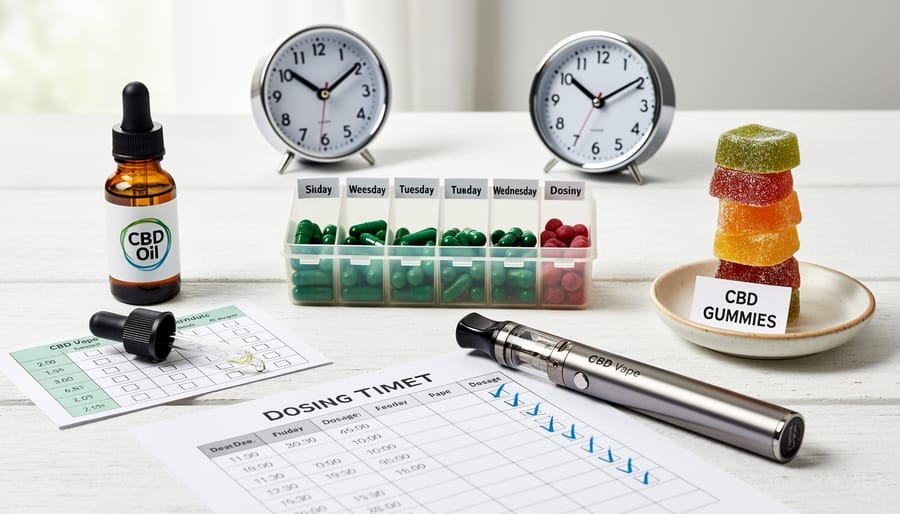
When you’re thinking about dosing frequency—whether that’s daily, weekly, or every eight weeks—understanding how your CBD product delivers cannabinoids makes a huge difference.
Fast-acting methods get CBD into your bloodstream quickly. Sublingual oils and tinctures, which you hold under your tongue for 30-90 seconds, typically take effect within 15-30 minutes because the CBD absorbs directly through the mucous membranes. Vaping works even faster, usually within minutes, though it’s worth noting that Health Canada has raised concerns about vaping products in general. These methods also leave your system relatively quickly—usually within 4-6 hours—which means you might need to dose multiple times throughout the day to maintain consistent effects.
On the flip side, slow-release products like edibles, capsules, and softgels take longer to kick in because they need to pass through your digestive system first. You’re looking at anywhere from 45 minutes to 2 hours before you feel effects. The upside? They last considerably longer—often 6-8 hours or more. This extended duration means you can dose less frequently while still maintaining steady CBD levels in your system.
Here’s where this connects to dosing schedules: if you’re using a fast-acting sublingual oil, you’ll naturally dose more frequently than someone using capsules. A q8w (every eight weeks) schedule would never apply to standard CBD products, regardless of delivery method. That kind of infrequent dosing is reserved for specific pharmaceutical medications with entirely different formulations designed for sustained release over weeks or months.
How Your Body Processes Different CBD Formats
Understanding how your body handles CBD can really help you figure out if a q8w (every eight weeks) schedule makes sense for you. When you take CBD, your body doesn’t just keep it circulating forever – it actively breaks it down and eliminates it through your liver and kidneys.
The delivery method you choose dramatically affects how long CBD remains active in your system. For instance, if you vape CBD (which is legal in Canada but less common than oils), it enters your bloodstream quickly but also leaves relatively fast, usually within a few hours. CBD oils that you take under your tongue typically stay active for about 4-6 hours. Meanwhile, CBD capsules and edibles, which need to pass through your digestive system first, can remain in your body longer – sometimes up to 12 hours or more.
Here’s where it gets interesting for dosing schedules: while a single dose might be “active” for several hours, CBD can accumulate in your fatty tissues with regular use. Some Canadians using CBD daily for chronic conditions find that after several weeks of consistent dosing, they’ve built up what researchers call a “steady state” – meaning there’s always some CBD in their system. This is completely different from a q8w approach, where you’d essentially be starting fresh each time, with no accumulation between doses.
Personalizing Your CBD Dosing Schedule: Beyond Q8W
Factors That Affect Your Ideal Schedule
While q8w dosing might appear on pharmaceutical schedules, CBD usage in Canada typically requires a much more personalized approach. Several key factors determine what dosing schedule works best for you, and understanding these can help you fix your CBD dosage effectively.
Your body weight plays a significant role in how CBD affects you. Generally, people with higher body weight may need larger doses to achieve the same effects as someone smaller, though this isn’t a hard rule. I’ve seen petite friends need higher doses than expected, which brings us to the next factor.
Metabolism varies dramatically between individuals. Some people process CBD quickly, meaning they might need more frequent dosing or higher amounts, while others metabolize it slowly and feel effects for extended periods. Your age, activity level, and even genetics influence your metabolic rate.
The condition you’re treating matters tremendously. Someone managing occasional sleep issues might only need CBD a few nights weekly, while someone dealing with chronic pain may benefit from consistent daily use. Severity of symptoms also impacts frequency and amount.
Product potency is crucial but often overlooked. A high-potency tincture means fewer drops needed compared to a lower concentration, affecting how often you’ll use your product. Always check the milligrams per serving, not just the total bottle content.
Finally, tolerance development can occur with regular CBD use, though it’s less pronounced than with THC. Some Canadian users report needing slight increases over time, while others maintain the same dose indefinitely.
Starting Safe: The Canadian Approach to CBD Dosing
When I first started exploring CBD, I was overwhelmed by all the different dosing schedules and recommendations floating around. Here’s what I’ve learned about the Canadian approach, which prioritizes safety and individualization.
Health Canada doesn’t specifically endorse q8w or any particular dosing schedule for CBD products, since most CBD is regulated as a natural health product or cannabis product rather than a prescription medication. However, the principle behind their guidance is universal: start low and go slow.
For most Canadians new to CBD, this means beginning with a low dose (typically 5-10mg) and maintaining that amount consistently for at least a week before making any changes. While q8w dosing (every 8 weeks) might work for prescription medications with long-lasting effects, CBD typically requires more frequent administration because it leaves your system relatively quickly.
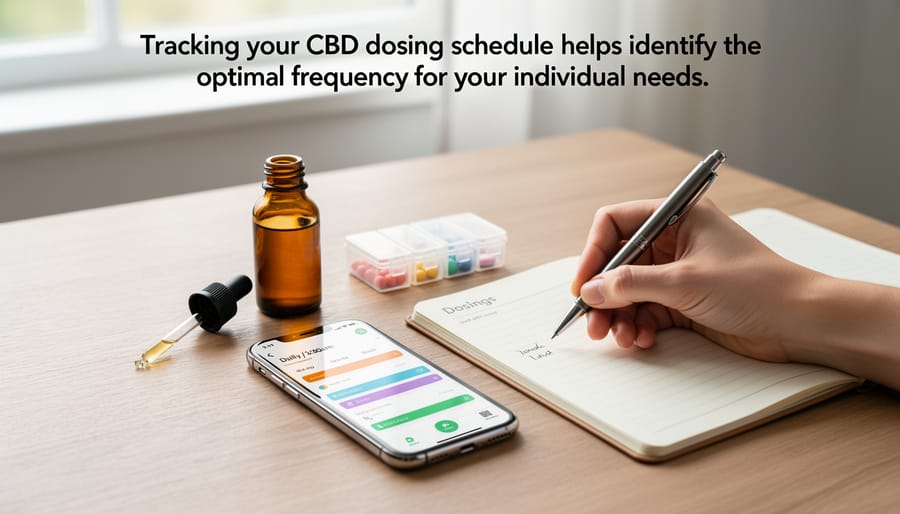
I recommend keeping a simple journal to track your CBD journey. Note the date, time, dose, delivery method (oil, capsule, vape), and any effects you notice over the next few hours and days. After a week of consistent dosing, assess whether you’re experiencing the benefits you’re seeking. If not, this might explain why CBD isn’t working for you yet.
Many Canadians find their sweet spot within 2-4 weeks of gradual adjustments. Remember, there’s no one-size-fits-all schedule. Your optimal dosing frequency depends on your individual body chemistry, the condition you’re addressing, and your chosen delivery method. Patience and careful observation are your best tools.
Real-World Dosing Schedules for Popular CBD Delivery Methods
CBD Oils and Tinctures: Daily to Twice-Daily Dosing
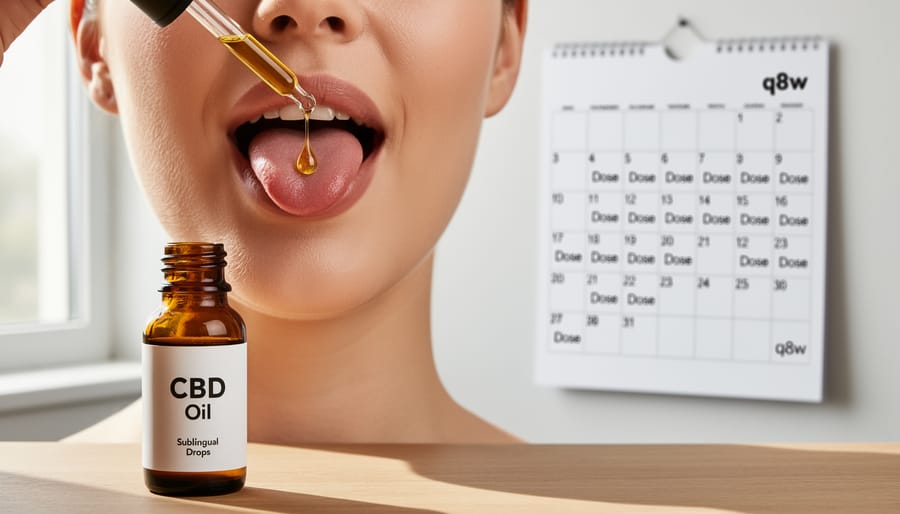
If you’re using CBD oils or tinctures in Canada, you’ll quickly realize that q8w dosing schedules aren’t really part of the conversation. Most people using sublingual CBD products dose daily or even twice daily, which is a completely different pattern from the once-every-eight-weeks approach.
Here’s why: CBD oils typically leave your system within 24 to 48 hours, so their effects are relatively short-lived. To maintain consistent levels in your body and experience ongoing benefits, you need regular, frequent dosing. I’ve personally found that taking my CBD oil once in the morning gives me steady support throughout the day, though some people I’ve spoken with prefer splitting their dose between morning and evening.
The beauty of oils and tinctures is their flexibility. You can adjust your dose daily based on how you’re feeling, which is the opposite of the rigid, infrequent q8w schedule used for certain long-acting medications. In Canada, product labels will typically recommend starting with a low daily dose and gradually increasing until you find what works for you.
Think of it this way: q8w dosing is designed for medications that stick around in your body for weeks, while CBD oils are more like a daily vitamin routine. They’re meant to be part of your regular wellness practice, not an occasional intervention.
CBD Edibles and Capsules: Consistent Daily Routines
CBD edibles and capsules offer a completely different experience when it comes to timing your doses. Unlike q8w dosing (every eight weeks), these oral products typically work on a daily schedule, but their effects last considerably longer than other methods like vaping or tinctures.
When you take a CBD capsule or edible, it needs to pass through your digestive system before entering your bloodstream. This means effects usually kick in after 45 minutes to two hours, but here’s the upside: they can last anywhere from six to eight hours, sometimes even longer. This extended duration makes them ideal for maintaining consistent CBD levels throughout your day without needing to redose frequently.
Many Canadians I’ve spoken with find success taking their CBD capsules at the same time each morning, much like a daily vitamin. Others prefer splitting their dose, taking one capsule in the morning and another in the evening to maintain coverage throughout their waking hours. The key is establishing a routine that fits your lifestyle.
Because edibles and capsules provide such sustained effects, you’re essentially creating your own personalized dosing schedule based on when you need support, rather than following a rigid medical protocol like q8w. Start with the manufacturer’s suggested serving size, give it at least a week to assess how it fits into your routine, then adjust timing or amount as needed.
CBD Topicals: As-Needed Application
Here’s where CBD dosing gets really different from traditional medications: topical products like creams, balms, and salves don’t follow rigid schedules at all. Unlike oral CBD or injected medications where q8w or similar timing matters for maintaining blood levels, topicals work locally at the application site and don’t enter your bloodstream in significant amounts.
I’ve found that most Canadians using CBD topicals apply them exactly when and where they need relief—maybe rubbing a CBD balm on sore muscles after a workout, or applying a cream to achy joints when discomfort flares up. There’s no “every 8 weeks” requirement here because the product isn’t building up systemically in your body.
That said, some people do develop personal routines with their topicals. You might apply a CBD lotion every morning as part of your skincare routine, or use a muscle balm nightly before bed. These schedules are about habit and preference, not medical necessity.
The one exception might be clinical trials studying CBD topicals for specific skin conditions, where researchers need consistent application schedules to measure results. But for everyday Canadian consumers? Think of CBD topicals like you would any moisturizer or muscle rub—use them when you need them, as often as feels right for your body.
When Long-Interval Dosing Like Q8W Makes Sense
Now, you might be wondering if Q8W dosing actually makes sense for your CBD routine. Let me be honest with you: in most CBD contexts, it probably doesn’t.
Q8W dosing comes from the pharmaceutical world where specific long-acting medications are designed to maintain therapeutic levels in your bloodstream for weeks at a time. Think of injectable biologics for conditions like rheumatoid arthritis or Crohn’s disease. These formulations are engineered at a molecular level to release slowly and steadily over extended periods.
CBD products available in Canada work very differently. When you take a CBD oil or capsule, your body typically processes it within hours to days, not weeks. The cannabinoids don’t linger in your system at consistent therapeutic levels the way a long-acting pharmaceutical injection would.
That said, there are scenarios where someone might adopt a more relaxed, infrequent CBD schedule. If you’re in a maintenance phase after finding significant relief from daily use, you might experiment with taking CBD only when you notice symptoms creeping back. Some people I’ve spoken with use CBD primarily for occasional sleep support or specific stressful situations rather than daily wellness, which creates its own irregular pattern.
But here’s the key distinction: choosing to use CBD occasionally based on your needs is completely different from following a structured Q8W medical protocol. CBD simply isn’t formulated to work that way in Canada’s current product landscape.
If you’re reading product literature that references Q8W or similar medical dosing schedules, it’s likely describing pharmaceutical research or medications rather than the CBD product itself. Always clarify with the manufacturer or your healthcare provider whether such terminology actually applies to what you’re considering purchasing, because mixing up pharmaceutical protocols with CBD supplementation could lead to ineffective use or unrealistic expectations.
Finding the right CBD dosing schedule is deeply personal, and q8w is just one option in your toolkit—not a one-size-fits-all solution. If you’ve come across this term on a product label or in CBD literature, remember that it originated in medical contexts where precision matters for prescription medications. While understanding q8w helps you make sense of dosing recommendations, it doesn’t mean this specific schedule is right for you.
I’ve learned through my own CBD journey that what works for one person might not work for another. Your body’s unique endocannabinoid system, the specific issues you’re addressing, and even your daily routine all influence the ideal dosing pattern. This is why working closely with a healthcare provider familiar with CBD use in Canada is so valuable. They can help you navigate Health Canada regulations while tailoring a schedule to your individual needs.
Starting with patience is key. Track your experiences in a simple journal—note the time you take CBD, the amount, and how you feel over the following hours and days. This information becomes invaluable for you and your healthcare provider when fine-tuning your approach.
Don’t feel pressured to adopt q8w dosing just because you’ve seen it mentioned. Some people thrive on daily use, others find every few days works better, and some discover that twice-weekly dosing hits the sweet spot. The beauty of CBD use in Canada today is the growing support for personalized approaches. Trust the process, stay informed, and remember that finding your ideal schedule is a journey worth taking thoughtfully.