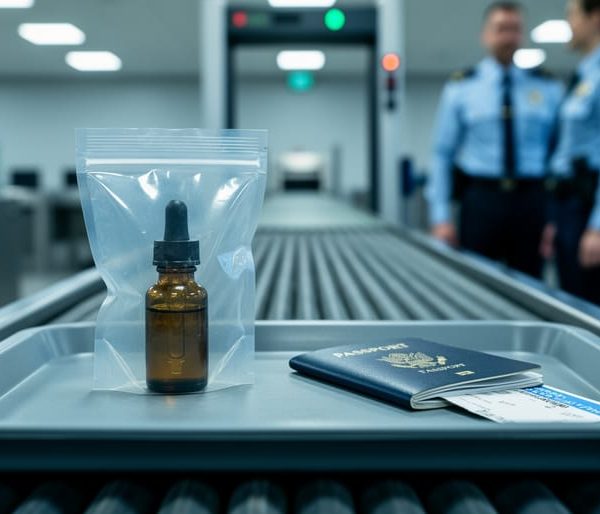
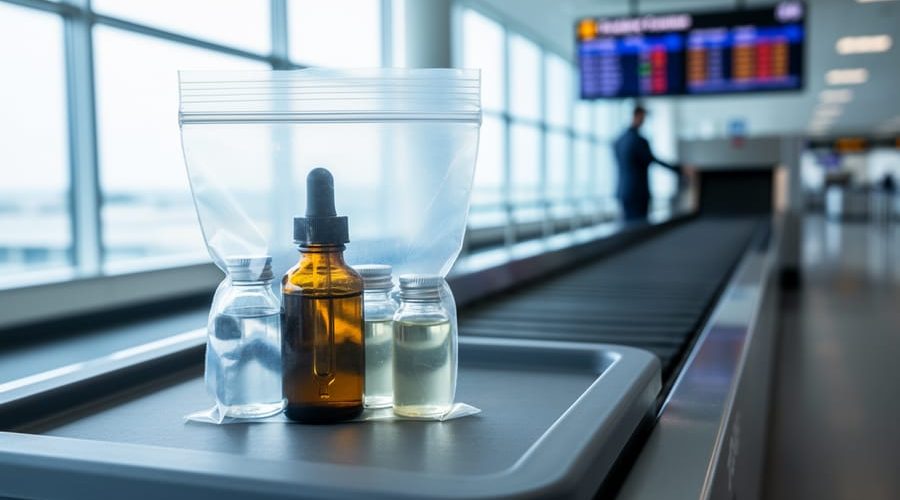
Pack your CBD oil in containers of 100ml or less, place them in a single clear, quart-sized resealable bag, and keep it separate from your carry-on for quick screening. That’s the 3-1-1 rule in action, the TSA regulation that governs all liquids, gels, and aerosols passing through airport security.
But here’s where things get complicated for Canadian travelers: following the liquid rules doesn’t mean you’re legally clear to fly internationally with CBD. While Canada legalized cannabis products in 2018, most countries maintain strict prohibitions, and CBD derived from cannabis remains illegal in many destinations. Even CBD products legal in your departure city can land you in serious legal trouble during layovers or at your final destination.
Transport security agents focus primarily on safety threats, not enforcing drug laws. However, if they discover your CBD during routine screening, they can refer you to law enforcement. International flights add layers of complexity because you’re subject to the laws of every country you touch down in, not just your origin and destination.
This creates a genuine dilemma for CBD users who rely on these products for wellness. You need clear, practical guidance that addresses both the mechanical packing requirements and the legal minefield of international cannabis laws. Understanding where CBD fits within the 3-1-1 framework is straightforward. Knowing whether you should actually bring it across borders requires deeper knowledge of Canadian regulations, international treaties, and country-specific cannabis policies.
What Exactly Is the Airport 3-1-1 Rule?
If you’ve ever been stopped at airport security with a full-sized bottle of shampoo, you’ve encountered the 3-1-1 rule in action. But what exactly does this rule mean, especially when you’re traveling with CBD oils or tinctures?
The 3-1-1 rule is a liquid restriction policy enforced by the Transportation Security Administration (TSA) in the United States and the Canadian Air Transport Security Authority (CATSA) in Canada. Here’s what those numbers represent:
3.4 ounces (100 milliliters): Each individual container of liquid, gel, aerosol, cream, or paste must not exceed this size. This applies to everything from toothpaste to CBD oil.
1 quart-sized bag: All your liquid containers must fit together in a single, clear, resealable plastic bag. In Canada, CATSA specifies this bag should be no larger than 1 liter (approximately 1 quart).
1 bag per passenger: Each traveler can only carry one of these liquid bags through security in their carry-on luggage.
So why does this rule exist? Following the 2006 transatlantic aircraft plot, where terrorists planned to use liquid explosives, aviation authorities worldwide implemented strict liquid restrictions. The specific volume limits were determined based on the amount of liquid needed to pose a security threat.
For CBD users, this means your 30ml tincture bottle is perfectly fine in your quart-sized bag, but that 120ml bottle you just bought won’t make it through security in your carry-on. You’ll need to either pack it in checked baggage or transfer the product to smaller, compliant containers.
One important note for Canadian travelers: CATSA follows essentially identical liquid rules to the TSA, so whether you’re flying domestically within Canada or internationally, the same 3-1-1 restrictions apply at Canadian airports. The containers must be clearly visible when you place your liquids bag in the screening bin, so keep it easily accessible at the top of your carry-on before reaching security.
Does CBD Oil Count as a Liquid Under the 3-1-1 Rule?
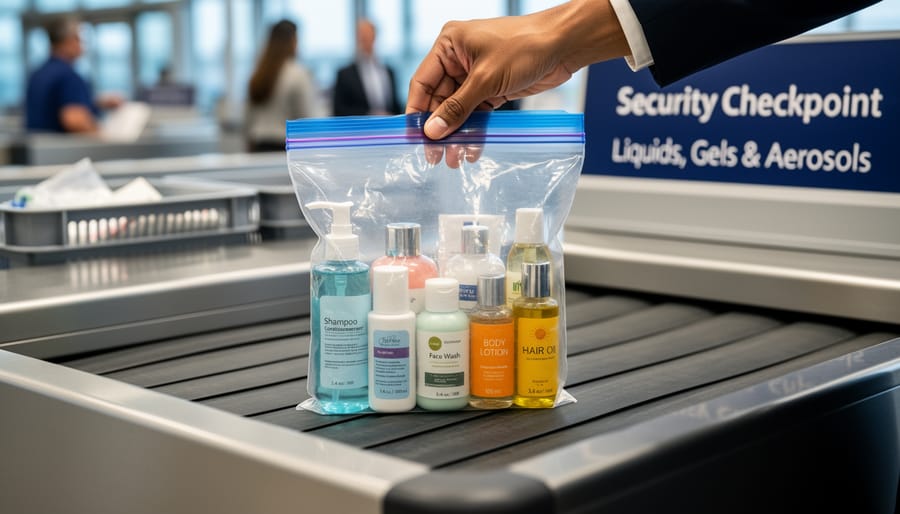
Yes, CBD oil absolutely counts as a liquid under the TSA’s 3-1-1 rule. If you’re carrying CBD oil or tinctures in your carry-on luggage, they must be in containers of 100 milliliters (3.4 ounces) or less, and all your liquid containers need to fit into a single one-liter clear, resealable plastic bag.
This same rule applies to other CBD products with liquid consistency. CBD vape juice, liquid topicals like lotions and balms, creams, and even some thicker products like salves fall under liquid restrictions. Essentially, if you can pour it, pump it, squeeze it, or spread it, airport security will likely treat it as a liquid.
However, not all CBD products count as liquids. CBD gummies, capsules, softgels, and even dried cannabis flower (where legal) don’t fall under the 3-1-1 rule since they’re solid forms. These can go in your carry-on without the liquid restrictions, though you’ll still need to consider the legal implications of traveling with any CBD product internationally.
Here are some practical tips for packing CBD oil compliantly. First, check the volume on your CBD bottle. Many tinctures come in 30ml bottles, which are well under the limit. If your bottle is larger, consider transferring some into a smaller travel-size container that clearly displays the volume. Keep your CBD oil in that clear plastic bag with your other liquids and remove it during security screening.
From my experience traveling within Canada, being organized and upfront about your CBD products makes the security process smoother. I once watched someone fumble through their bag looking for a large CBD bottle they’d forgotten about, which created unnecessary delays and scrutiny. Before you even consider packing CBD, remember that while these packing rules apply, the bigger question is whether CBD is legal at your destination, which we’ll explore in the next section.
The Real Problem: International Transit and CBD Legality
Flying Within Canada: What You Need to Know
Good news for domestic travelers: CBD is legal across Canada, which makes flying within the country significantly more straightforward than international travel. When you’re flying between Canadian provinces or territories, you can bring your CBD products along without the legal complications that come with crossing international borders.
Under Health Canada guidelines, CBD products are legal as long as they contain no more than 0.3% THC. This applies whether you’re flying from Vancouver to Toronto or taking a quick hop between smaller cities. Your CBD oil, capsules, or topicals are perfectly fine to pack in your carry-on or checked luggage, as long as they meet this THC threshold.
If you’re bringing CBD oil or tinctures in your carry-on, remember they still need to follow the standard 3-1-1 liquid rules: containers must be 100ml or less and fit in a single clear, resealable bag. I’ve flown domestically with my CBD oil countless times, and I always keep it in the original packaging with the label clearly visible. This makes things smoother if a security officer has questions.
While you’re not legally required to carry documentation for domestic flights, I always recommend keeping your product’s certificate of analysis or purchase receipt handy. It shows the THC content and confirms you purchased from a legitimate source. Canadian airport security officers are generally familiar with CBD products, but having proof that your product meets legal requirements can save time and stress at security checkpoints.
Leaving Canada: Where Your CBD Becomes Risky
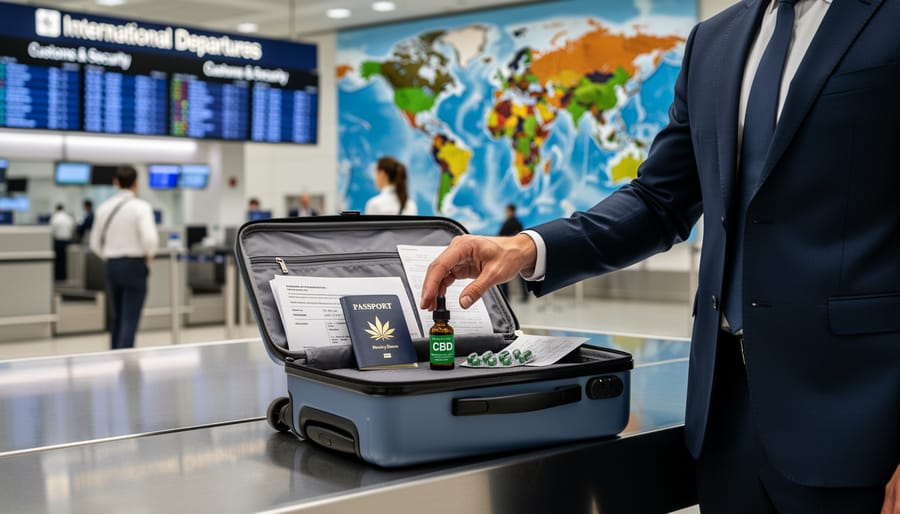
Here’s where things get serious. While you might be perfectly legal carrying your CBD within Canada, the moment you board an international flight, you’re entering a completely different legal territory—and the consequences can be life-altering.
I learned this the hard way during a trip planning session when a friend casually mentioned bringing her CBD oil to Dubai. After some frantic research, we discovered she could have faced years in prison. That was a sobering wake-up call about how drastically CBD laws vary worldwide.
The rule is simple but unforgiving: your destination country’s laws apply the second you land, and in some places, CBD is treated identically to illegal drugs. Countries like the United Arab Emirates, Japan, Singapore, Thailand, and South Korea have zero-tolerance policies. We’re talking potential imprisonment, heavy fines, and deportation—even for trace amounts in products you bought legally in Canada.
Even countries that seem progressive can surprise you. Some European nations have strict THC limits that differ from Canada’s standards, meaning your legally purchased Canadian CBD might contain too much THC for their regulations.
Layovers add another layer of complexity. If you’re connecting through a country where CBD is prohibited, you could face legal issues even if you never leave the airport. Transit laws vary, and not all airports offer the same protections.
Before traveling internationally with CBD, research your destination’s specific laws thoroughly. Check official government websites or contact their embassy in Canada. When in doubt, leave it at home. No CBD product is worth risking your freedom, facing international legal battles, or dealing with a criminal record that could affect future travel for years to come.
The Layover Trap: When You’re Not Even Leaving the Airport
Here’s something many Canadian travelers don’t realize until it’s too late: even if you’re just passing through an airport and never actually entering the country, you can still face legal consequences for what’s in your carry-on.
I learned this the hard way during a layover in Dallas. I wasn’t leaving the airport, just changing planes, but my CBD oil was still subject to U.S. federal law the moment I landed on American soil. The transit vs. entry distinction? It doesn’t exist when it comes to what you’re carrying.
Think of it this way: the second your plane touches down in another country, you and your belongings are technically in that country’s jurisdiction, even if you’re staying airside. Some airports have designated international transit zones where different rules might apply, but CBD is tricky because it often falls into grey areas regardless of where you’re standing.
For Canadians, this matters most at common layover hubs. If you’re connecting through U.S. airports like Seattle, Chicago, or any American city, remember that CBD remains federally illegal in the United States, even though some states have their own laws. Your Canadian purchase could become contraband mid-journey.
United Kingdom layovers present different challenges. While CBD is legal there, it must contain less than 0.2% THC (compared to Canada’s 0.3% limit), and products must be properly licensed. Your perfectly legal Canadian CBD might not meet UK requirements.
European hubs vary wildly. Amsterdam’s Schiphol might seem lenient given the Netherlands’ reputation, but Dutch law has specific CBD regulations. Frankfurt, Paris, and other major European connection points each have their own rules.
The riskiest scenario? When you don’t even know you’re technically entering a country. Some layovers require you to collect and recheck baggage, which means going through customs, even briefly. Others keep you airside but still subject to local aviation security laws.
My advice? If your journey involves any layover in a country where CBD’s legal status is questionable, leave it at home. The convenience isn’t worth the risk of detention, fines, or worse.
Country-by-Country Quick Reference for Canadian Travelers
United States (The Complicated Neighbor)
Here’s where things get particularly tricky for Canadian travelers. Even though CBD is legal across Canada and in many U.S. states, crossing the border with it remains genuinely risky.
The core issue? In the United States, cannabis laws operate on two conflicting levels. Federally, cannabis remains a Schedule I controlled substance, which technically includes CBD derived from marijuana plants. While the 2018 Farm Bill legalized hemp-derived CBD (with less than 0.3% THC) at the federal level, enforcement remains inconsistent. Since airports and border crossings fall under federal jurisdiction, you’re subject to federal law, not state law.
The Transportation Security Administration has stated they don’t specifically search for cannabis products, but if discovered during screening, they’re required to refer the matter to law enforcement. What happens next depends entirely on the individual officer and local policies.
From my conversations with Canadian travelers, I’ve heard stories ranging from confiscation without further issue to missed flights due to questioning. One friend lost her expensive CBD oil at a connecting flight in Denver, despite Colorado’s legal status.
Even if you’re flying to a cannabis-friendly state like California or Colorado, you’re still passing through federally-controlled checkpoints. The risk simply isn’t worth it when you can purchase CBD legally at your U.S. destination, if needed.
European Union Destinations
The European Union presents a complicated landscape for Canadian travelers carrying CBD products. While the EU generally permits CBD products containing less than 0.2% THC, each member country maintains its own specific regulations. This means your layover location matters significantly.
If you’re connecting through major European hubs like London Heathrow, Amsterdam Schiphol, or Frankfurt Airport, you’ll encounter different enforcement approaches. The United Kingdom (post-Brexit) allows CBD products that meet specific criteria, while the Netherlands has permissive policies despite CBD existing in a legal grey area. Germany permits CBD products under the 0.2% THC threshold.
Here’s my honest advice from experience: even if your CBD oil meets the 3-1-1 liquid requirements and you’re just transiting through Europe, the legal complexity isn’t worth the risk. I’ve heard from fellow travelers who faced questioning at European customs simply because regulations weren’t clearly understood by security personnel themselves. Some countries like Slovakia and Lithuania maintain stricter stances on CBD products.
Unless you’re absolutely certain about the specific laws at your layover destination and final European country, consider purchasing CBD locally at your destination or simply leaving it at home for your trip.
Countries Where You Absolutely Cannot Bring CBD
Before you pack that CBD oil for your international trip, here’s a reality check: some countries have zero-tolerance policies that could land you in serious legal trouble, regardless of what’s legal back home in Canada.
Countries where CBD is completely prohibited include the United Arab Emirates (including Dubai and Abu Dhabi), Japan, Singapore, South Korea, Thailand (despite recent changes to their cannabis laws, CBD remains highly restricted), Indonesia, Malaysia, and the Philippines. In these destinations, CBD is treated the same as any illegal drug, and penalties can be severe—we’re talking hefty fines, imprisonment, or even deportation.
I can’t stress this enough: even if your CBD product contains zero THC and is perfectly legal in Canada, it doesn’t matter at international borders. These countries don’t distinguish between cannabis derivatives. Even having trace amounts in your luggage or system could result in arrest.
My advice? Leave your CBD at home when traveling to these destinations. It’s simply not worth the risk, no matter how much you rely on it for wellness purposes.
How to Pack CBD for Air Travel (If It’s Legal at Your Destination)
If you’ve confirmed CBD is legal at your destination and any layover locations, here’s how to pack it properly for air travel from Canada.
Start by keeping your CBD products in their original packaging. This is crucial because the labels show important information like THC content (which should be under 0.3% for legal hemp-derived CBD), batch numbers, and manufacturer details. TSA agents and customs officers want to verify what you’re carrying, and original packaging makes this process smoother.
I learned this lesson the hard way on a trip to California. I’d transferred my CBD oil into a smaller travel bottle to save space, and it raised questions at security. The agent couldn’t verify what was in the bottle, which led to additional screening and nearly missing my flight. Now I always travel with products in their original containers, even if they’re bulkier.
For liquid CBD products like oils or tinctures, the 3-1-1 rule applies: containers must be 3.4 ounces (100ml) or less, all fitting in one quart-sized clear plastic bag. If your CBD oil bottle is larger, you’ll need to either purchase a smaller size for travel or pack it in checked baggage where liquid restrictions don’t apply.
Bring your Certificate of Analysis (COA) if possible. This laboratory document proves your product’s cannabinoid content and can be downloaded from most reputable manufacturers’ websites. Print it out and keep it with your CBD products. While not always required, it provides official documentation if questions arise.
Pack CBD in your carry-on rather than checked baggage. This keeps it accessible if you need to present it to security, and you won’t risk losing it if your luggage goes missing. Plus, extreme temperature changes in cargo holds can affect product quality.
Keep all documentation together in one easily accessible spot, including your COA, receipts, and any medical recommendations if you have them. Being organized shows you’re traveling responsibly and legally.

What Happens If You’re Caught With CBD at Airport Security?
Let’s be honest about what could happen if airport security finds CBD in your luggage.
Within Canada, the consequences are typically minimal. If you’re flying domestically and have CBD products that don’t comply with the 3-1-1 rule, security will likely just confiscate the oversized liquid. I’ve heard from readers who had large CBD oil bottles taken away at security checkpoints, and that was the end of it. No charges, no drama, just a disappointing loss of an expensive product.
International travel is where things get serious. The consequences depend entirely on your destination country’s laws. In the best case scenario, security confiscates your CBD and you continue your journey without it. In moderate cases, you might face fines or be denied entry to the country. Worst case? Some countries treat CBD as a controlled substance, which could result in detention, criminal charges, or even imprisonment.
Here’s something reassuring: authorities generally distinguish between honest mistakes and intentional smuggling. If you accidentally packed CBD gummies in your carry-on and forgot about them, explaining the situation honestly usually results in simple confiscation. Security officers deal with confused travelers daily and understand that cannabis laws vary dramatically by jurisdiction.
That said, ignorance of the law isn’t a legal defense in most countries. If you’re traveling internationally from Canada, the safest approach is simply leaving your CBD at home or purchasing it at your destination if legal there. The risk just isn’t worth it for most travelers.
Alternatives to Traveling With Your CBD Products
If traveling with CBD feels too complicated or risky, you have several practical alternatives that can make your trip much simpler.
One of the easiest options is purchasing CBD products at your destination, assuming it’s legal there. Many countries and states now have their own CBD markets, so you might find what you need locally. This eliminates the stress of crossing borders with cannabis products entirely. Just make sure to research the local laws before your trip to confirm CBD is actually permitted where you’re heading.
Taking a tolerance break during your travels is another straightforward solution. I’ve done this myself on longer trips, and honestly, it’s sometimes refreshing to reset. If you use CBD for wellness purposes rather than medical necessity, a few days without it probably won’t make a significant difference. You can always resume your routine once you’re back home in Canada.
If you really need CBD while traveling, consider switching to non-liquid forms like capsules, soft gels, or edibles. These don’t fall under the 3-1-1 rule, which removes one complication from the equation. However, you’ll still need to navigate the international legality issues, so this doesn’t solve everything.
Shipping your CBD products ahead to your destination is theoretically possible, but I’d be cautious with this approach. Mail services cross international borders too, and packages can be inspected by customs. If you’re staying somewhere within Canada, this becomes much more viable.
Finally, consider alternative wellness products during your trip. Natural supplements like melatonin for sleep, magnesium for relaxation, or herbal teas might provide similar benefits without any legal complications. Sometimes the simplest solution is the best one.
Here’s the reality: getting your CBD through airport security under the 3-1-1 rule is actually the easy part. You’ve got your liquid or tincture in a 100ml bottle, tucked into your clear bag, and TSA-equivalent screening at a Canadian airport? You’ll likely sail through without issue.
The real concern, and what deserves your attention, is legality. Before you pack that CBD oil for your tropical vacation or European adventure, you need to do your homework. Research the cannabis and CBD laws not just for your final destination, but for every country where you’ll have a layover. I can’t stress this enough—even if you’re just changing planes and never leave the airport, you’re technically on that country’s soil and subject to their laws.
Yes, it feels like a lot of research for a wellness product that’s perfectly legal here at home. But a few minutes of Googling beats hours of interrogation or worse. Check government travel advisories, contact your destination’s embassy if you’re unsure, and when in doubt, leave it at home.
Bookmark this guide for reference as you plan future trips, and check back periodically. Cannabis laws worldwide are evolving rapidly, and what’s prohibited today might be acceptable tomorrow (or vice versa). Travel informed, stay safe, and enjoy your journey knowing you’ve covered all your bases.