

Visualize your endocannabinoid system as a network of cellular receptors spread throughout your body like a complex subway map, with CB1 receptors concentrated in your brain and nervous system while CB2 receptors cluster in your immune cells and peripheral tissues. This internal mapping system doesn’t operate randomly—it follows a precise 24-hour schedule that dictates when your body is most responsive to cannabinoids, whether they’re produced naturally or come from your CBD oil.
Understanding this timing connection matters more than most Canadians realize. When I first started exploring CBD for my own sleep challenges five years ago, I noticed my evening dose worked differently than my morning one, but I couldn’t explain why. The answer lies in how your endocannabinoid system synchronizes with your circadian rhythm, the internal clock that governs everything from cortisol release to body temperature fluctuations throughout the day.
Your body produces peak levels of endocannabinoids like anandamide during specific windows, typically highest in the early morning and lowest in the evening. This natural ebb and flow affects how CBD interacts with your system depending on when you take it. A diagram of this relationship reveals why some people experience energizing effects from morning CBD while others find it sedating at night—it’s not just about the product itself, but when your receptors are primed to receive it.
For Canadians navigating the legal CBD market, understanding this connection transforms random supplementation into strategic wellness planning. The timing of your dose might be just as important as the dosage itself, and grasping this visual relationship between systems empowers you to optimize your routine based on biological reality rather than guesswork.
What Is the Endocannabinoid System? A Visual Breakdown

The Key Players in Your ECS
Think of your endocannabinoid system as having three main types of players, all working together like a well-coordinated team. Understanding who does what makes the whole system much easier to grasp.
First up are the receptors. CB1 receptors are primarily found in your brain and central nervous system, which is why they have such a significant influence on mood, memory, pain perception, and yes, your sleep-wake cycle. They’re concentrated in areas like your hippocampus, cerebellum, and hypothalamus. CB2 receptors, on the other hand, hang out mostly in your immune system and peripheral tissues. They’re your inflammation managers, working quietly in the background to keep your immune responses balanced.
Then we have the endocannabinoids themselves, the molecules your body produces naturally. Anandamide, sometimes called the “bliss molecule,” and 2-AG are the two main players here. Your body creates these on demand when it needs them. Anandamide is particularly fascinating because it’s involved in regulating mood and motivation, while 2-AG is your body’s most abundant endocannabinoid and plays a major role in managing pain and inflammation.
Finally, there are the enzymes that break down these endocannabinoids once they’ve done their job. FAAH breaks down anandamide, while MAGL handles 2-AG. This breakdown process is crucial because it prevents overstimulation and keeps everything in balance.
When I first learned about these components, I realized why timing my CBD intake mattered so much. Each element influences different body functions at different times throughout your day.
How Cannabinoids From Cannabis Fit Into the Picture
Now that you understand how your body’s internal endocannabinoid system works, let’s explore how cannabis-derived compounds enter this picture. When you consume cannabis products, cannabinoids like CBD and THC interact with the same receptors and pathways your body naturally uses.
Think of it this way: your endocannabinoid system has locks (receptors), and your body produces its own keys (anandamide and 2-AG). Cannabis simply provides additional keys from an external source. THC, for example, directly binds to CB1 receptors in your brain, which explains its psychoactive effects. This is a key reason why CBD differs from THC in how it makes you feel.
CBD takes a more subtle approach. Rather than directly binding to CB1 or CB2 receptors, it influences them indirectly. CBD helps prevent the breakdown of your natural endocannabinoids, essentially allowing your body’s own compounds to work longer and more effectively. It also interacts with other receptor systems beyond the ECS, which contributes to its wide-ranging effects on sleep, mood, and inflammation.
If you’re still learning about what CBD is, this indirect mechanism is important to understand because it explains why CBD doesn’t produce a high like THC does.
In Canada, CBD products derived from licensed producers are legal and regulated under the Cannabis Act. This means Canadians have access to quality-tested products with known cannabinoid content, making it easier to understand exactly how much CBD you’re introducing to your endocannabinoid system. When choosing CBD products, you’re essentially selecting tools to support your body’s existing regulatory framework.
Your Body’s Natural 24-Hour Rhythm Explained
What Controls Your Internal Clock
Your body doesn’t just randomly decide when to feel sleepy or alert. There’s actually a tiny cluster of nerve cells in your brain, called the suprachiasmatic nucleus (SCN), that acts as your body’s master clock. Think of it as the conductor of an orchestra, keeping all your biological rhythms in sync.
The SCN sits right above where your optic nerves cross, which isn’t a coincidence. Its location allows it to receive direct information about light exposure from your eyes. When light hits your retina, signals travel to the SCN, telling it whether it’s day or night. This is why bright light in the morning helps you wake up, while dimming the lights in the evening signals your body to wind down.
Scientists call these environmental cues “zeitgebers,” which literally means “time-givers” in German. Light is the strongest zeitgeber, but your internal clock also responds to other signals like meal timing, exercise, temperature changes, and even social interactions. Here in Canada, our dramatic seasonal light changes can really throw these signals off, especially during those short winter days.
What’s fascinating is that your endocannabinoid system communicates directly with the SCN, which is why the timing of your CBD use can matter more than you might think. Understanding these natural rhythms helps explain why some people find CBD more effective at certain times of day.

Why Your Body Does Different Things at Different Times
Your body isn’t just running on autopilot the same way all day long. Think about it: you naturally feel more alert around mid-morning, your stomach starts growling around the same time each day, and you get that afternoon energy slump like clockwork. These aren’t random occurrences – they’re your circadian rhythm at work.
Throughout each 24-hour cycle, your body orchestrates an impressive array of timed processes. Your cortisol levels peak in the early morning to help you wake up, while melatonin rises in the evening to prepare you for sleep. Your body temperature actually drops at night and climbs during the day, typically reaching its highest point in late afternoon. This is partly why you might feel more energized for a workout around 4 or 5 PM.
Your metabolism also follows a schedule. Research shows your body processes food more efficiently earlier in the day, which is why that late-night snack might sit heavier than your morning breakfast. Even your pain tolerance fluctuates – many Canadians I’ve spoken with notice their chronic pain feels worse at certain times of day.
I’ve personally experienced this with my own CBD routine. I used to take my CBD oil whenever I remembered, but once I understood these natural rhythms, I started timing it more intentionally. The difference in how I felt was remarkable, and it made me realize how important it is to work with your body’s natural schedule rather than against it.
The Surprising Connection: How Your ECS Changes Throughout the Day
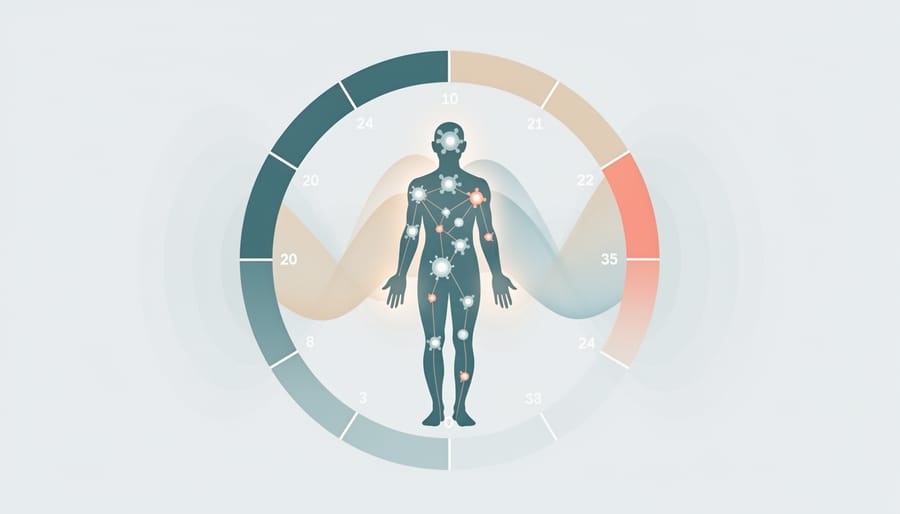
Endocannabinoid Levels Rise and Fall Like Waves
Your endocannabinoid levels aren’t static throughout the day. They actually fluctuate in rhythmic patterns, much like the tides. Research shows that anandamide and 2-AG follow distinct daily patterns, though scientists are still mapping out exactly how these waves work.
Studies suggest that anandamide levels tend to be higher during waking hours and dip as bedtime approaches. This makes sense when you consider that anandamide is often called the “bliss molecule” and helps regulate mood and motivation during active hours. Meanwhile, 2-AG appears to follow a slightly different pattern, with levels that may peak at different times depending on various factors like stress and physical activity.
I’ve noticed this personally when experimenting with CBD timing. Taking it in the morning seemed to energize me, while evening doses helped me wind down. It wasn’t just the CBD working alone but likely how it was interacting with my body’s natural endocannabinoid rhythms.
In practical terms, this means your body’s internal cannabis-like compounds are already working on a schedule. Understanding this can help you time your CBD use more strategically, working with your body’s natural waves rather than against them.
Your Receptors Are More Sensitive at Certain Times
Here’s something I find fascinating: your endocannabinoid receptors don’t operate at the same level of sensitivity throughout the day. Recent research shows that CB1 and CB2 receptor expression actually fluctuates based on your circadian rhythms, which has pretty significant implications for when you take your CBD.
Studies have found that CB1 receptor density peaks during your active hours and dips during rest periods. This means your brain’s cannabinoid receptors are potentially more responsive in the morning and afternoon than late at night. CB2 receptors, which are heavily involved in immune function, show their own rhythmic patterns that sync with your body’s natural inflammation cycles.
What does this mean for your CBD routine? Well, if you’re taking CBD for focus and alertness, morning doses might work with your naturally higher receptor sensitivity. For sleep support, though, you’re working against lower receptor expression, which is why some people need higher evening doses to achieve the same effect.
I started paying attention to this after noticing my morning CBD seemed to hit differently than my evening dose, even when using the same product. Once I understood the receptor fluctuation piece, it made complete sense. This is why tracking your CBD timing alongside your symptoms can reveal patterns you might otherwise miss.
The Sleep-Wake Cycle Connection
Your ECS doesn’t just respond to light and dark signals from your circadian clock—it actively participates in regulating when you feel alert and when you feel sleepy. The endocannabinoid anandamide naturally fluctuates throughout the day, with levels rising in the evening to promote sleep and falling in the morning to support wakefulness. CB1 receptors in your brain’s sleep-wake centers respond to these changing endocannabinoid levels, influencing everything from REM sleep cycles to morning alertness.
This is exactly why timing your CBD matters so much. When I first started using CBD, I took it randomly throughout the day and couldn’t figure out why my results were inconsistent. Once I understood this connection, everything clicked. For CBD for sleep support, taking it 60-90 minutes before bed works with your body’s natural evening endocannabinoid rise, potentially enhancing that drowsy feeling. Conversely, lower daytime doses at consistent times may support steady energy without interfering with your natural wake signals.
Think of it this way: your ECS is already following a schedule, orchestrating when various cannabinoid receptors are most active. By timing your CBD to align with these natural patterns rather than working against them, you’re essentially speaking your body’s language. This synchronization explains why someone might feel energized from morning CBD but sleepy from the same dose at night.
What This Means for Your CBD Routine
Morning CBD Use: What to Expect
When you take CBD in the morning, you’re introducing it to your ECS at a time when your body is naturally gearing up for activity. Your cortisol levels peak within 30 minutes of waking, which is actually helpful for alertness and focus. Your endocannabinoid system is already working to keep your stress response balanced, and CBD can support this process without interfering with that natural morning energy boost.
I’ve found that morning CBD works differently than evening doses. Instead of feeling sleepy, many people report a sense of calm focus, like taking the edge off morning anxiety without losing motivation. This happens because CBD isn’t directly sedating. It’s helping your ECS maintain balance while your circadian system is saying “time to be awake and alert.”
For morning use, consider lower doses than you might take at night, typically between 10-25mg depending on your tolerance. Product types that work well in the AM include CBD oil drops that you can take with breakfast, capsules for convenience, or even CBD-infused coffee if you’re a caffeine drinker. Some Canadians I’ve spoken with prefer vaping or sublingual oils for faster onset when dealing with morning stress.
The key is that morning CBD supports your ECS without fighting against your natural circadian wake signal. You’re essentially giving your body extra tools to handle the day’s demands while staying mentally sharp.
Evening CBD Use: Supporting Natural Wind-Down
As evening approaches, your endocannabinoid system naturally shifts gears to support rest and recovery. This is when strategic CBD use can work harmoniously with your body’s wind-down signals rather than against them.
I’ve found that timing matters significantly here. Taking CBD about 60-90 minutes before your intended bedtime allows it to interact with your ECS as cortisol levels drop and melatonin production increases. This isn’t about forcing sleep, but rather supporting the natural transition your body is already trying to make.
For Canadians looking to optimize evening CBD use, oils and tinctures offer flexibility with dosing and faster absorption compared to capsules. I typically suggest starting with 15-25mg in the evening, though your ideal dose may differ. Some people find that pairing CBD with calming herbal teas creates a relaxing ritual that signals to both mind and body that it’s time to unwind.
Product selection matters here. Look for quality CBD products that have been third-party tested and contain minimal additional ingredients that might interfere with sleep. Full-spectrum options may provide enhanced benefits through the entourage effect, though broad-spectrum works well for those avoiding even trace THC amounts.
One practical tip: keep your evening CBD dose consistent in timing. Your endocannabinoid system responds well to predictable patterns, reinforcing your natural circadian rhythm over time.
Finding Your Personal Sweet Spot
Here’s the truth I’ve learned through years of working with CBD users across Canada: there’s no one-size-fits-all answer to timing your dose. Your endocannabinoid system operates on its own unique schedule, influenced by your personal circadian rhythm, lifestyle, and individual biology.
The best approach? Treat this as a friendly experiment with yourself. Start by choosing one consistent time to take your CBD for at least five to seven days. Morning users might try taking their dose with breakfast, while evening users could align it with dinner or an hour before bed. The key is consistency during this initial trial period so you can accurately assess how your body responds.
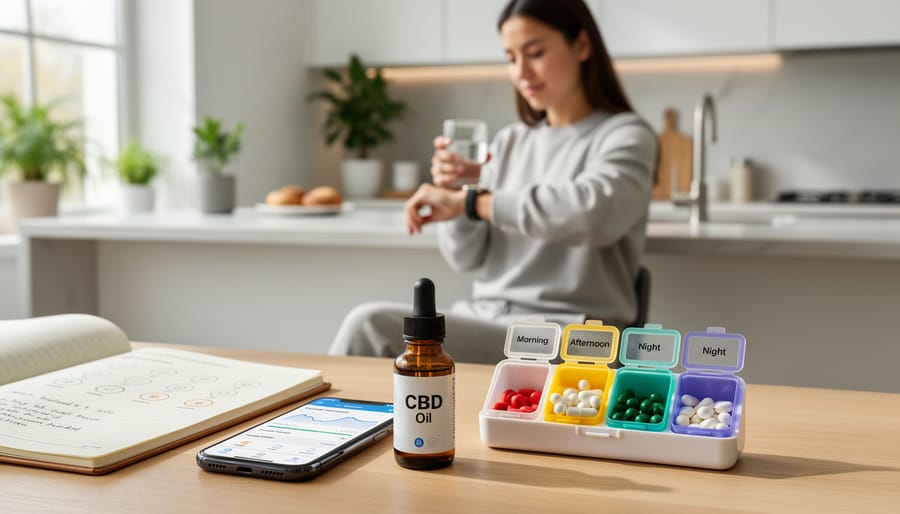
I always recommend keeping a simple journal during this discovery phase. Nothing fancy is needed, just note the time you took your CBD, the dose, and how you felt throughout the day. Track your energy levels, sleep quality, mood, and any specific symptoms you’re addressing. After a week, review your notes. Are you feeling energized when you need rest? Drowsy during your productive hours? These insights are gold.
Don’t hesitate to adjust. If morning doses leave you feeling too relaxed during work hours, try shifting to early afternoon. If evening doses aren’t improving your sleep, experiment with taking them earlier in the evening or even at lunch. Remember to refer back to our CBD dosing guide as you make these adjustments, since timing and dosage often work hand-in-hand.
Your circadian rhythm is as unique as your fingerprint, so give yourself permission to find what works specifically for you.
When Your Internal Clock Gets Disrupted
Shift Workers and CBD: Special Considerations
If you’re among the many Canadians working night shifts, rotating schedules, or irregular hours, your endocannabinoid system faces unique challenges. Your body is trying to maintain internal rhythms while your external schedule conflicts with natural light-dark cycles, which can disrupt both your ECS and circadian system simultaneously.
I’ve spoken with several nurses and healthcare workers who’ve shared how challenging it is to time CBD when their “morning” is actually 7 PM. The key is to anchor your CBD routine to your personal wake-sleep cycle rather than clock time. If you sleep from 9 AM to 5 PM, treat 5 PM as your morning and plan accordingly.
Consider taking energizing CBD products with your first meal after waking, regardless of whether that’s breakfast at dawn or dinner at dusk. Your endocannabinoid system responds to your personal rhythms, not the sun’s position. For sleep support, use CBD about 30-60 minutes before your intended sleep time, even if that means taking it at 8 AM while your neighbours are commuting to work.
Many shift workers find success using blackout curtains and consistent meal timing alongside CBD to reinforce their shifted schedule. Since your ECS helps regulate appetite and sleep pressure, maintaining predictable routines for CBD dosing, eating, and sleeping helps your system adapt to non-traditional hours more effectively.
Seasonal Changes in Canadian Climates
Living in Canada means experiencing some of the most dramatic seasonal light changes in the world. I remember my first winter in Winnipeg – by 4:30 PM it was pitch dark, and I felt like I was constantly exhausted. Those extreme variations between our long winter nights and bright summer evenings don’t just affect your mood; they can significantly impact both your circadian rhythms and endocannabinoid system function.
During Canadian winters, reduced daylight exposure can suppress your body’s natural production of endocannabinoids while also disrupting melatonin production. This double impact helps explain why so many of us experience winter fatigue, mood changes, and disrupted sleep patterns. Your ECS relies on environmental cues just like your circadian system does, and when we’re getting barely eight hours of daylight in December, both systems can struggle.
For those long winter months, consider using CBD earlier in your evening routine – perhaps around 5 or 6 PM rather than right before bed. This gives your ECS support during that abrupt transition from daylight to darkness that our bodies haven’t fully adapted to. Light therapy boxes can also help maintain more consistent circadian signaling, which in turn supports healthier ECS function.
Summer presents the opposite challenge. When it’s still bright at 10 PM in Vancouver or even later further north, your body might not recognize it’s time to wind down. Using blackout curtains and taking CBD about two hours before your intended sleep time can help signal to both systems that rest is approaching, regardless of what’s happening outside your window.
Common Questions About ECS Timing and CBD
Let me address some of the questions I hear most often when people start paying attention to how their ECS and circadian rhythms work together. These come up constantly in conversations, so you’re definitely not alone if you’ve been wondering about them too.
Does consistency matter more than perfect timing?
Here’s the honest answer: consistency wins every time. I’ve talked to so many people who stress themselves out trying to take CBD at the exact same minute each day, and that stress probably does more harm than the “perfect” timing does good. Your ECS responds beautifully to predictable patterns, but it’s not watching the clock down to the second.
Think of it like eating meals. Your body adapts when you generally eat breakfast around the same time, but being 30 minutes off one day isn’t going to derail everything. The same applies to CBD. If you normally take it at 9 PM but one night it’s 9:45, you’re fine. What matters is establishing a routine your body can anticipate and respond to. From my experience, people who take CBD within the same general window daily see better results than those who bounce all over the schedule, even if that schedule is theoretically “optimized.”
Can you reset or retrain your ECS timing?
Yes, absolutely. Your endocannabinoid system is remarkably adaptable, which is both good news and something to be mindful of. If you’ve been taking CBD at random times or want to shift your routine, your ECS will adjust, but give it time. I usually suggest allowing at least two weeks for your body to fully adapt to a new timing pattern.
When I shifted my own CBD routine from mornings to evenings, I noticed it took about ten days before I stopped feeling slightly “off” in my energy patterns. Your endocannabinoid receptors need time to recalibrate their sensitivity and response patterns. During this transition period, keep your dosage consistent and resist the urge to increase it just because you’re not feeling the effects you’re used to. Patience really pays off here.
Will CBD interact with medications I take at specific times?
This is an important one, and I always recommend having this conversation with your healthcare provider, especially if you’re taking prescription medications. CBD can interact with certain medications by affecting how your liver processes them, particularly drugs that come with a “grapefruit warning.”
That said, timing can sometimes help minimize interactions. Some people find that spacing CBD and certain medications by several hours reduces potential issues. In Canada, pharmacists are generally well-informed about CBD interactions, and I’ve found them incredibly helpful when I’ve had questions. Don’t hesitate to bring your CBD products with you to show them exactly what you’re using, including the cannabinoid profile and dosage information.
What about Canadian-specific products for circadian support?
In Canada, we’re fortunate to have access to regulated CBD products specifically formulated with circadian rhythm support in mind. Look for products from licensed producers that combine CBD with complementary ingredients like melatonin for evening use or energizing terpenes for daytime. These are legal and readily available through provincial retailers and licensed online sources.
One thing I appreciate about Canadian products is the mandatory testing and labeling requirements. You know exactly what you’re getting, which matters tremendously when you’re trying to establish timing-based routines. The consistency between bottles means your body can actually develop that predictable response pattern we’ve been discussing.
Your endocannabinoid system isn’t sitting still. It’s constantly moving, adjusting, and responding to the world around you and inside you. Think of it less like a machine with an on-off switch and more like a dance partner, responding to the rhythm of your day, your meals, your sleep, and yes, the timing of your CBD dose.
Throughout my years of researching and writing about CBD for Canadians, I’ve learned that the when matters almost as much as the what. I remember one reader from Vancouver who’d been taking CBD every evening and wondering why it wasn’t helping her morning anxiety. Once she shifted part of her dose to breakfast time, everything changed. That’s the beauty of understanding how your ECS flows with your circadian rhythms.
Here in Canada, we’re fortunate to have access to legal, regulated CBD products, which means we can experiment safely with timing strategies. Whether you’re taking CBD oil in the morning to support daytime alertness or using it before bed to ease into sleep, you’re working with your body’s natural patterns, not against them.
I’d love to hear from you. Have you noticed differences in how CBD affects you at different times of day? What timing strategies have worked best for your needs? Your experiences help build our understanding and support other Canadians navigating their CBD journey.
Remember, my commitment is always to provide you with evidence-based, practical information tailored to the Canadian context. Your endocannabinoid system is unique to you, and finding your optimal timing is part of discovering what works for your body.