
Check the milligrams listed on your CBD product label, then compare that exact number to the cannabinoid profile on the Certificate of Analysis. If a tincture claims 1000mg of CBD but the COA shows test results of only 850mg, you’ve found a 15% discrepancy that signals either poor quality control or misleading marketing.
Calculate the potency per serving by dividing the total CBD content by the number of doses in the container. A 30ml bottle claiming 33mg per dropper should contain approximately 1000mg total CBD. When the math doesn’t align with COA results, you’re looking at a product that won’t deliver the effects you’re paying for.
Request batch-specific COAs directly from manufacturers rather than relying on generic lab reports displayed on websites. Each production batch varies, and companies committed to transparency will provide the exact COA matching the batch number printed on your product. If they can’t or won’t supply this documentation, that’s your clearest red flag.
Examine the testing date on the COA and ensure it’s recent, ideally within the past six months. CBD degrades over time, and a COA from two years ago tells you nothing about the potency of the product currently in your hands. Canadian consumers deserve current, accurate information before making purchasing decisions.
When I first started researching CBD products available in Canada, I discovered that nearly 40% showed significant discrepancies between label claims and actual COA results. This gap between marketing promises and laboratory reality costs consumers money and undermines trust in an industry that should prioritize accuracy. Learning to evaluate these claims yourself transforms you from a hopeful buyer into an informed consumer who demands accountability.
What Are Potency Claims and Why Should You Care?
When I first started exploring CBD products in Canada, I remember staring at a bottle label that claimed “500mg CBD” and feeling completely lost. Was that a lot? A little? And how could I be sure the bottle actually contained what it promised? If you’ve ever felt that confusion, you’re definitely not alone.
Potency claims are the numbers you see on CBD product labels that tell you how much CBD, THC, or other cannabinoids are inside. You’ll typically see these expressed in milligrams (mg) per container or per serving. For example, a tincture might claim “1000mg CBD per bottle” or “33mg CBD per dropper.” These numbers matter for two crucial reasons: getting the right dose and getting good value for your money.
Think about it this way—if you’re taking CBD for sleep and find that 25mg works for you, you need to know that each dose actually contains close to that amount. Too little and you won’t experience the benefits you’re seeking. The potency claim also helps you compare prices between products. A $40 bottle with 500mg CBD costs more per milligram than a $60 bottle with 1000mg.
Here’s where things get interesting. In Canada, licensed cannabis producers are required to test their products and provide documentation proving those potency claims are accurate. This documentation is called a Certificate of Analysis, or COA for short. Think of a COA as a report card for your CBD product—it shows exactly what’s inside based on independent laboratory testing.
COAs verify not just cannabinoid content, but also check for contaminants like pesticides, heavy metals, and microbial growth. They’re your best tool for confirming that what you’re buying matches what’s advertised on the label. Unfortunately, not all products live up to their claims, which is why learning to read and compare COAs against product labels is an essential skill for any CBD consumer in Canada.
Understanding Certificates of Analysis (COAs)
What Information Should a COA Include?
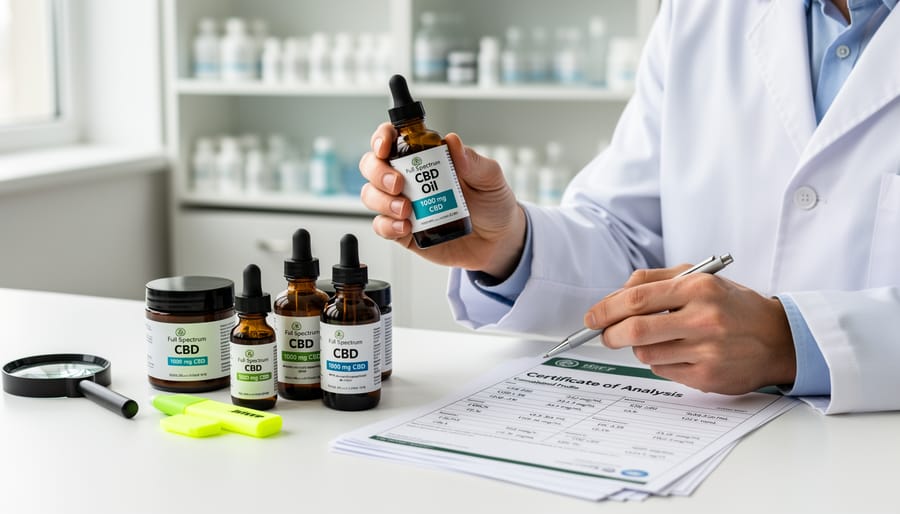
A comprehensive Certificate of Analysis isn’t just a piece of paper—it’s your roadmap to understanding exactly what’s in your CBD product. Think of it as a detailed report card that should answer all your questions about quality and safety.
At the top of your priority list should be the cannabinoid profile. This section breaks down the concentration of CBD, THC, and other cannabinoids present in the product. In Canada, remember that legal CBD products must contain no more than 10mg of THC per package, so this is crucial information to verify. The COA should list these amounts in milligrams per gram (mg/g) or as percentages.
Next, look for the terpene profile. These aromatic compounds aren’t just about smell—they contribute to the overall effects of your CBD product through what’s called the entourage effect. While not every COA includes terpene testing, reputable brands often provide this additional layer of transparency.
Contaminant testing is where safety really comes into play. A thorough COA will show results for pesticides, heavy metals, residual solvents, and microbial contaminants like mould or bacteria. You want to see “ND” (not detected) or results well below Health Canada’s safety thresholds.
Don’t overlook the administrative details either. Every COA should display a unique batch or lot number matching your product, the testing date (ideally recent), and clear lab credentials including accreditation information. The lab’s contact details and testing methods should also be transparent. When I first started reviewing COAs, I’d skip over these seemingly boring details, but they’re actually your assurance that the testing is legitimate and traceable.
How to Find a Product’s COA
Finding a Certificate of Analysis shouldn’t feel like a treasure hunt, but honestly, it sometimes does. The good news is that reputable Canadian CBD companies are making it easier than ever to access these important documents.
Start by checking the product packaging itself. Many brands now include QR codes that you can scan with your smartphone camera to pull up the COA instantly. I’ve found this particularly common with newer Canadian brands trying to build trust with consumers.
If there’s no QR code, head to the company’s website. Most legitimate retailers have a dedicated section for lab results or certificates of analysis—usually found in the footer menu under “Lab Results,” “Quality,” or “Transparency.” Some companies organize COAs by product name or batch number, which you’ll find printed on your product label.
Can’t locate it online? Don’t hesitate to contact the company directly. Send an email or use their chat feature asking for the COA for your specific batch number. A trustworthy company will provide it promptly, usually within 24-48 hours. If they seem evasive, can’t produce one, or tell you they don’t have third-party testing, that’s a significant red flag.
For products purchased from brick-and-mortar retailers in Canada, ask the staff if they have COAs available. Quality shops should either have them on hand or know how to help you access them from the manufacturer.
Red Flags in COA Presentation
When evaluating COAs, certain warning signs should make you pause before purchasing. If a company doesn’t provide COAs at all, that’s an immediate red flag—legitimate Canadian CBD brands should have nothing to hide. I’ve encountered several websites where finding test results felt like a treasure hunt, buried three pages deep or requiring you to email customer service. Transparency should be straightforward, not complicated.
Check the date on any COA you find. Results older than six months may not reflect the current product batch, especially since cannabinoid profiles can degrade over time. The testing lab’s credentials matter too—look for accredited facilities, not unknown operations without proper licensing. In Canada, reputable labs should follow ISO standards.
Watch for vague or incomplete information. A proper COA should clearly identify the specific batch number that matches your product, list individual cannabinoids and contaminants tested, and include the lab’s contact information. If any of these elements are missing, or if the company seems evasive when you ask questions about their testing practices, consider shopping elsewhere. Your health deserves products backed by complete, current documentation.
Common Discrepancies Between Label Claims and COA Results
Overstated CBD Content
This is one of the most common issues I come across when reviewing products. A brand claims their tincture contains 1000mg of CBD, but the COA shows only 850mg. Sometimes this happens due to natural degradation—CBD content can decrease slightly over time due to light exposure, heat, or simply age. This is why checking the COA date matters so much.
Health Canada allows for some variance in cannabinoid content, typically around 10-15%, recognizing that natural products can fluctuate. If a product label says 1000mg and the COA shows 900mg, that’s within an acceptable range. However, if you’re seeing discrepancies of 20% or more, that’s a red flag.
I once purchased a CBD oil claiming 30mg per milliliter, but the COA revealed it contained only 18mg—a 40% difference. That’s not natural variance; that’s either poor quality control or intentional mislabeling. Either way, it eroded my trust in that brand completely.
When evaluating overstated claims, calculate the percentage difference. Subtract the actual COA result from the label claim, divide by the label claim, then multiply by 100. Anything over 15-20% should concern you. Remember, you’re paying based on that stated potency. If the product consistently underdelivers, you’re not getting what you paid for, and that’s unacceptable regardless of whether it’s intentional or negligent.
Unexpected THC Levels
One of the most concerning discrepancies you might find when checking COAs is unexpected THC levels. While CBD products sold in Canada must contain no more than 10 mg of THC per package for non-licensed products, or follow provincial cannabis regulations for licensed ones, some products might show higher amounts than listed on the label.
I remember chatting with a reader named Marcus who nearly faced issues at work because his “THC-free” CBD oil actually contained trace amounts that showed up on a drug test. He’d never thought to check the COA until it was too late. This situation is more common than you’d think.
When reviewing the THC section of your COA, compare the reported percentage against what the label claims. Even if a product advertises “zero THC” or “non-detect,” the COA might reveal small amounts present. For Canadians subject to workplace drug testing or those concerned about impairment, these details matter significantly.
If you find THC levels higher than advertised, contact the company immediately and consider switching brands. Keep documentation of both the label claims and COA results. Some companies may have made honest labeling errors, while others might be deliberately misleading customers—either way, it’s information you need to make safe, informed choices.
Missing or Undetectable Cannabinoids
Sometimes a COA might not show certain cannabinoids that a product claims to contain. This is particularly important when you’re looking at full-spectrum or broad-spectrum products that advertise multiple cannabinoids working together.
If a label says “full-spectrum” but the COA only shows CBD and THC, something’s off. Full-spectrum products should display a range of minor cannabinoids like CBG, CBC, or CBN. Similarly, if a product advertises specific therapeutic cannabinoids but they’re absent from test results, you’re not getting what you paid for.
I once purchased a product marketed as containing CBN for sleep support, but when I checked the COA, CBN wasn’t even listed in the results. It was a frustrating discovery that taught me to always verify these claims before making assumptions about a product’s effects.
In Canada, this issue matters because Health Canada requires accurate labeling. If cannabinoids are advertised but missing from testing, it could indicate poor quality control, outdated COAs that don’t match current batches, or misleading marketing.
When you spot missing cannabinoids, reach out to the company for clarification. They should be able to explain why certain compounds aren’t showing up or provide updated test results. If they can’t give you a satisfactory answer, consider it a red flag and look for brands with more transparent testing practices.
How to Evaluate Claims Against COA Results: A Step-by-Step Process
Step 1: Locate and Access the COA
Finding your product’s Certificate of Analysis is easier than you might think. Most reputable CBD brands make COAs readily available, though the exact location can vary by company.
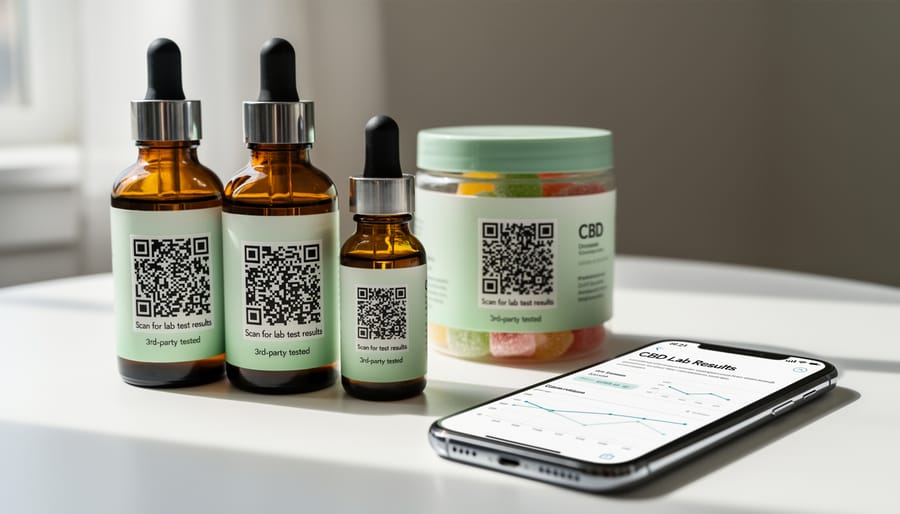
Start by checking the product packaging itself—many manufacturers print a QR code directly on the label that links to the batch-specific COA. Simply scan it with your phone’s camera to access the document instantly.
If there’s no QR code, visit the brand’s website and look for a section labeled “Lab Results,” “Test Results,” or “Certificates of Analysis.” You’ll typically need your product’s batch number or lot number, which is printed on the packaging (often near the expiration date). Enter this number into their search tool to pull up your specific results.
When I first started checking COAs, I was surprised how transparent good brands are about this information. If you can’t locate the COA after checking both the packaging and website, reach out to the company’s customer service directly. Under Canadian regulations, licensed producers must maintain these records, and any legitimate brand should provide them promptly upon request. If they can’t or won’t share the COA, that’s a significant red flag about the product’s quality and the company’s transparency.
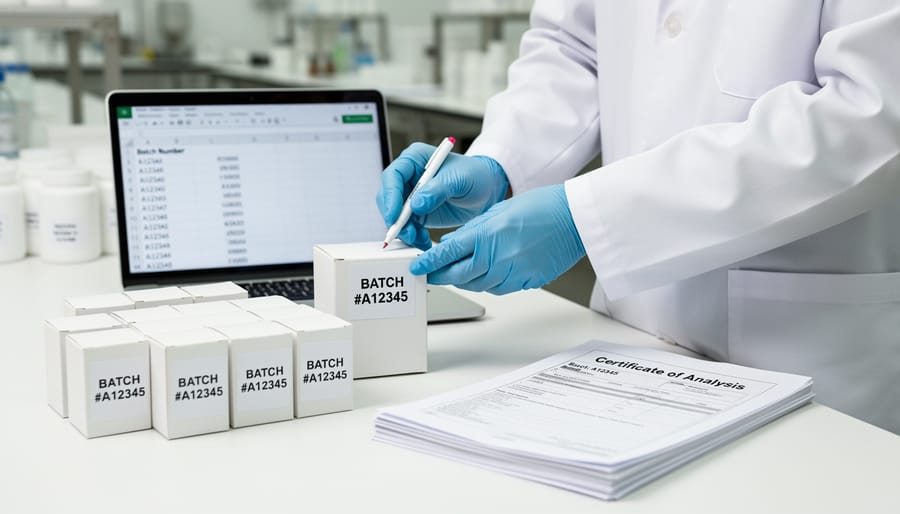
Step 2: Match Batch Numbers
Here’s your first reality check: a COA is only useful if it actually corresponds to the product you’re holding. This might sound obvious, but you’d be surprised how often this step gets overlooked. Every CBD product should have a batch number or lot number printed somewhere on the packaging—usually on the bottom of the bottle or box. The COA you’re reviewing must display this exact same number.
Why does this matter so much? Because manufacturers produce multiple batches of the same product throughout the year, and potency can vary between batches due to differences in raw materials or processing conditions. A COA from a different batch tells you nothing about what’s actually in your bottle.
I learned this lesson the hard way when I once assumed all bottles of the same product were identical. After noticing inconsistent effects, I checked the batch numbers and realized I’d been comparing the wrong COA. Now I always verify this first—it takes five seconds and ensures everything else you’re about to evaluate is actually relevant to your purchase.
Step 3: Compare Cannabinoid Percentages and Totals
Now comes the practical part—converting percentages to actual milligrams and comparing what you find. Don’t worry, the math is straightforward, and I’ll walk you through it.
Most COAs list cannabinoid content as percentages. To convert this to milligrams, you need to know the total product weight. For oils, this is typically listed in milliliters on the label, but you’ll need to convert it to milligrams (1 mL of CBD oil weighs roughly 950 mg, though this varies slightly).
Here’s the simple formula: multiply the percentage by the total product weight in milligrams, then divide by 100.
For example, if your 30 mL bottle shows 5% CBD on the COA, the calculation looks like this: 5 × (30 × 950) ÷ 100 = 1,425 mg of CBD. If the label claims 1,500 mg, you’re seeing a small discrepancy.
When I first started checking my products this way, I was surprised to find some were slightly under—not dramatically, but enough to matter when budgeting for monthly supply.
For edibles or capsules, the weight is usually clearly marked, making calculations easier. A 10 mg gummy with 1% CBD would contain 0.1 mg—a significant underdose if the label promises 10 mg.
Acceptable variance is typically within 10-15% due to natural extraction variations, but anything beyond that deserves scrutiny.
Step 4: Check Testing Dates and Lab Credentials
A COA is only valuable if it’s current and comes from a trustworthy source. When Danielle first started reviewing COAs, she didn’t realize how important these details were until she discovered a company reusing test results from batches produced over a year earlier—definitely a red flag.
Check the testing date on the COA and compare it to your product’s batch number and manufacture date. Ideally, testing should have occurred within a few months of production. If the dates don’t align or seem outdated, the results may not accurately reflect what’s in your bottle.
Next, verify the laboratory credentials. In Canada, reputable CBD companies typically use ISO/IEC 17025 accredited labs, which follow strict quality standards. The COA should clearly display the lab’s name, location, and accreditation details. You can usually verify a lab’s accreditation through a quick online search.
Be wary of vague lab names or COAs that lack complete contact information. Legitimate third-party labs are transparent about their credentials and easy to verify. If something feels off or you can’t confirm the lab’s legitimacy, reach out to the company directly for clarification before purchasing.
Step 5: Assess Acceptable Variance
Here’s the thing about CBD products: they’re made from plants, and plants aren’t manufactured in factories. That means some natural variation is completely normal. When I first started comparing labels to COAs, I panicked over tiny differences until I learned what’s actually acceptable.
Generally, a variance of plus or minus 10% from the label claim is considered standard industry practice. So if your bottle says 1000mg CBD, anywhere from 900mg to 1100mg on the COA is reasonable. This accounts for natural fluctuations in hemp extracts and testing methodology differences between labs.
However, anything beyond that 10% range should raise concerns. If your 1000mg product tests at 750mg or lower, that’s a significant discrepancy suggesting quality control issues or misleading labelling. Similarly, if it tests dramatically higher, you’re not getting what you paid for in terms of accurate dosing.
In Canada, licensed products undergo stricter oversight, so major variances are less common but still worth checking.
What to Do When Claims Don’t Match Results
Contact the Company First
Before writing off a product entirely, consider reaching out to the company directly. Sometimes discrepancies have reasonable explanations that aren’t immediately obvious. For instance, I once contacted a brand about a THC level that seemed slightly off, and they explained they’d recently reformulated the product but hadn’t updated their website yet—the COA was actually more current than their label.
Companies might also clarify testing methodology differences, explain batch variations, or provide updated COAs if yours is outdated. A reputable Canadian CBD company should respond promptly and transparently to your concerns. Their willingness to engage in this conversation tells you a lot about their integrity. If they’re dismissive, defensive, or can’t provide satisfactory answers, that’s a red flag. However, many legitimate businesses appreciate the opportunity to address confusion and maintain customer trust. Keep your inquiry polite but direct, stating exactly which numbers don’t match and asking for clarification.
Report to Health Canada
If you discover a CBD product with significant discrepancies between its label claims and COA results, you have the right to report it to Health Canada. This is particularly important if the potency difference could affect dosing safety or if you suspect the product violates cannabis regulations.
Health Canada operates a consumer product incident reporting system specifically for cannabis products. You can file a report online through their website or by calling their toll-free number at 1-866-234-2345. When reporting, include details like the product name, brand, purchase location, and specific discrepancy information from the COA compared to the label.
I’ve reported products before when I noticed THC levels exceeding legal limits—it felt empowering to contribute to consumer safety. Health Canada investigates these complaints and may take enforcement action against non-compliant companies, including product recalls or penalties.
Keep your product packaging, receipts, and copies of the COA as documentation. Even if you’re unsure whether something warrants reporting, Health Canada encourages consumers to share concerns. Your report helps regulators identify patterns and protect other Canadians from potentially misleading or unsafe products.
Share Your Experience Responsibly
Once you’ve verified your CBD product’s claims against its COA, consider sharing your findings with the community. Your honest review can help other Canadian consumers make informed decisions. When I discovered a significant discrepancy in a product I’d purchased, I shared my experience on community forums, and several others confirmed similar findings with the same brand.
If you’re sharing your experience, stick to the facts. Report specific numbers from the COA and label, avoid emotional language, and give the company a chance to respond before posting publicly. Remember, occasional small variations are normal, but consistent major discrepancies deserve attention.
Consider leaving reviews on the retailer’s website or sharing in Canadian CBD communities. If you found a product that delivered exactly what it promised, that’s equally worth sharing. Your experiences contribute to a more transparent marketplace where quality brands can stand out and questionable ones are held accountable. Just ensure your feedback remains fair, accurate, and focused on verifiable information rather than personal preferences.
Why These Discrepancies Happen (And What Canada Is Doing About It)
If you’ve ever wondered why a CBD product doesn’t quite match its Certificate of Analysis, you’re not alone—and there are actually some legitimate reasons this happens, even with honest manufacturers.
First, let’s talk about the elephant in the room: cannabis is a plant, and plants are naturally variable. Even with careful cultivation, the CBD content in hemp can fluctuate based on growing conditions, harvest timing, and extraction methods. A batch tested during production might show slightly different results than a sample tested months later after sitting on a shelf. It’s similar to how the vitamin C content in an orange changes depending on when it was picked and how long it’s been stored.
Testing methodology also plays a significant role. Different laboratories use different equipment, protocols, and even different reference standards. While accredited labs follow strict guidelines, there’s still room for variation between facilities. A product tested at Lab A might show 24mg CBD per serving, while Lab B reports 26mg from the same batch. Both could be technically correct within their margin of error.
Then there’s the reality of degradation. CBD isn’t shelf-stable forever. Exposure to light, heat, and oxygen gradually breaks down cannabinoids over time. A product that tested at 30mg per serving when manufactured might drop to 27mg six months later—which is why checking the testing date on a COA matters just as much as the numbers themselves.
I remember chatting with a small Canadian producer who explained how devastating even small variations could be for their business. They were doing everything right, but natural plant variation meant one batch tested at 22mg instead of their labeled 25mg. It wasn’t intentional, but it still technically violated labeling requirements.
That said, understanding these challenges doesn’t mean accepting poor quality control. Health Canada has been working to tighten regulations around CBD products, particularly as the market has grown since cannabis legalization. Licensed producers under the Cannabis Act must follow strict testing and labeling requirements, with random inspections and mandatory batch testing.
For products sold as natural health products or cosmetics containing CBD, the rules are evolving. Health Canada continues to clarify which products fall under which regulatory framework, and enforcement has been increasing. Companies that consistently mislabel or make exaggerated claims face warnings, product seizures, and potential legal action.
The bottom line? Some discrepancies are understandable and manageable, while others signal quality control problems or dishonesty. Your job as a consumer is learning to tell the difference—and that’s exactly what checking COAs helps you do. Canadian regulations are improving, but informed consumers remain the best quality control mechanism available.
You now have the essential tools to evaluate potency claims and protect yourself from misleading marketing in Canada’s CBD marketplace. While reading Certificates of Analysis might have seemed intimidating at first, you’ve learned that with a few straightforward steps—checking batch numbers, comparing cannabinoid percentages, and watching for red flags—you can confidently verify what’s actually in the products you’re considering.
I remember feeling completely overwhelmed the first time I tried to understand a COA. The numbers, the testing methods, the legal jargon—it all seemed designed to confuse rather than clarify. But once I learned what to look for, everything changed. I started catching discrepancies that would have otherwise gone unnoticed, and I became much more selective about which brands earned my trust and my dollars.
Verification isn’t about being cynical or distrusting every company. It’s about being informed and empowered. The CBD brands that care about their customers want you to ask questions, request documentation, and hold them accountable. Those relationships, built on transparency and evidence, are the ones worth nurturing.
As Canadian consumers, we deserve products that deliver on their promises. By taking a few extra minutes to evaluate claims against actual test results, you’re not just protecting yourself—you’re raising standards across the entire industry. Every informed purchase decision sends a message that accuracy and honesty matter. You’re ready to become the empowered CBD consumer you set out to be.