
Look for products labeled “THC-free,” “zero THC,” or “broad spectrum” when shopping for CBD edibles in Canada—these terms indicate the THC has been completely removed through additional refinement processes, unlike “full spectrum” products that contain trace amounts. Request a Certificate of Analysis (COA) from third-party labs before purchasing any zero THC product, as this document confirms the exact cannabinoid content and proves no detectable THC remains, typically measured at less than 0.001%.
Purchase exclusively from licensed Canadian retailers, whether online or in-store, since Health Canada regulations require rigorous testing standards that protect you from mislabeled products. The difference matters tremendously if you face workplace drug testing, have THC sensitivity, or simply prefer avoiding any psychoactive compounds while still accessing CBD’s potential benefits for sleep, anxiety, or discomfort.
Zero THC CBD edibles provide the reassurance many Canadians need—whether you’re a healthcare professional subject to random screenings, someone who experienced unwanted effects from THC, or a beginner wanting the most predictable introduction to cannabinoids. Understanding what truly qualifies as THC-free, where to find legitimate products, and how Canadian regulations protect consumers empowers you to make confident choices. The Canadian market offers gummies, chocolates, capsules, and beverages specifically formulated without THC, giving you access to CBD’s properties without compromise or concern.
What Does ‘0 THC CBD’ Really Mean?
The Three Types of CBD Extracts
When I first started learning about CBD, I was honestly confused by all the different types of extracts. Let me break this down in a way that finally made sense to me.
There are three main types of CBD extracts, and understanding them is crucial if you’re specifically looking for zero THC options.
Full-spectrum CBD contains everything from the hemp plant, including up to 0.3% THC. In Canada, this is legally considered hemp, but it’s definitely not THC-free. If you’re searching for 0 THC products, full-spectrum isn’t what you want, period.
Broad-spectrum CBD is the middle ground. Manufacturers start with full-spectrum extract and then remove the THC through additional processing. The goal is to keep all the other beneficial compounds like minor cannabinoids and terpenes while eliminating THC. However, here’s where it gets tricky: some broad-spectrum products may still contain trace amounts of THC, even if it’s below detectable limits. For edibles, this matters because you’re consuming the product internally, and those traces can potentially accumulate in your system.
CBD isolate is pure cannabidiol, period. It’s at least 99% pure CBD with everything else stripped away. This is the only extract type that guarantees absolutely zero THC. When it comes to edibles specifically, isolate-based products are your safest bet if you need complete THC avoidance for drug testing, personal health reasons, or THC sensitivity.
For edibles in particular, knowing your extract type matters more than with topicals because ingested CBD stays in your system longer. I always recommend checking third-party lab reports that specifically test for THC content, not just assuming a product labeled “THC-free” actually is. Canadian regulations require accurate labeling, but independent verification gives you extra peace of mind.
How THC is Removed from CBD Products
Creating zero THC CBD products requires precision and specialized techniques that go beyond standard CBD extraction processes. Manufacturers use several methods to ensure every trace of THC is eliminated while preserving the beneficial cannabinoids and terpenes.
The most common approach is called chromatography, which sounds complex but works on a simple principle: different compounds move through a filtering system at different speeds. Think of it like sorting marbles by size through a series of screens. THC molecules separate from CBD molecules, allowing manufacturers to collect pure CBD without any THC tagging along.
Another method involves using CBD isolate as the starting point. This crystalline powder contains 99 percent pure CBD with all other compounds already removed during processing. When manufacturers use isolate to create edibles, oils, or other products, they’re starting with a guaranteed THC-free base.
Some companies also employ distillation techniques, repeatedly heating and cooling the extract to separate compounds based on their boiling points. Since THC and CBD have different boiling temperatures, this allows for precise separation.
What makes these processes trustworthy in Canada is the rigorous testing that follows. Licensed producers must verify THC levels through third-party lab testing before products reach consumers. These labs can detect even tiny amounts of THC, ensuring that zero THC products truly live up to their name and meet Health Canada’s strict standards for accuracy and safety.
Why Choose Zero THC CBD Edibles?
Drug Testing Concerns
Let’s be honest about something many Canadians face: workplace drug testing. Even though cannabis is legal in Canada, many employers still test for THC, especially in safety-sensitive positions like transportation, healthcare, and construction. If you’re subject to regular drug screening, even the legal 0.3% THC found in full-spectrum CBD products could potentially show up on a test.
I’ve heard from readers who work in fields with zero-tolerance policies. For them, the peace of mind that comes with truly THC-free CBD is invaluable. Professional athletes subject to anti-doping regulations, law enforcement officers, and commercial drivers all fall into this category where any detectable THC could jeopardize their careers.
Here’s what you need to know: standard drug tests look for THC metabolites, not CBD. However, if you’re using a full-spectrum product regularly, trace amounts of THC can accumulate in your system. While unlikely, it’s theoretically possible to trigger a positive result, especially with sensitive testing methods.
This is exactly why third-party lab testing matters so much. Before choosing any product marketed as zero THC, verify the Certificate of Analysis shows non-detectable THC levels, typically listed as “ND” or below the limit of quantification. This documentation can provide both reassurance and potential evidence if questions arise.
Sensitivity to THC Effects
I’ll be honest with you – I’ve talked to so many people who thought CBD just wasn’t for them because even the tiniest amount of THC caused problems. One friend described feeling “uncomfortably aware of my own breathing” after a single 5mg edible, which really stuck with me. If you’ve experienced anxiety, racing thoughts, paranoia, or that unsettling “too high” feeling from THC, you’re not alone, and you’re not being overly sensitive.
Some people are genuinely more sensitive to THC’s psychoactive effects due to individual brain chemistry, metabolism, or even genetics. What feels like a mild buzz to one person can be overwhelming to another. This is exactly why true 0 THC products exist – they’re not just for drug testing purposes.
In Canada, you have legitimate options. CBD isolate products contain absolutely no THC, giving you all the potential wellness benefits without any psychoactive risk. I’ve seen people who had sworn off cannabis completely find relief with isolate-based edibles because they finally felt in control of their experience.
The key is choosing products that explicitly state “0% THC” or “THC-free” and come with third-party lab testing to verify it. Don’t settle for “low THC” if even trace amounts affect you – there’s no shame in knowing your limits and choosing what works for your body.
Legal and Personal Preferences
Not everyone who chooses 0 THC CBD does so because of drug testing or health concerns. Many Canadians simply prefer to avoid THC altogether for personal reasons. Some find that even trace amounts of THC don’t align with their lifestyle choices, while others avoid it for religious or philosophical beliefs. I’ve spoken with users who appreciate the wellness benefits of CBD but want complete certainty they’re not consuming any psychoactive compounds, and that’s an entirely valid preference.
From a legal standpoint, certain professions in Canada require absolute sobriety or have strict substance policies. Even though CBD with less than 0.3% THC is federally legal, some employers maintain zero-tolerance policies that don’t distinguish between cannabinoids. If you work in transportation, healthcare, law enforcement, or other safety-sensitive fields, choosing genuinely THC-free products removes any potential workplace complications. Always check your employer’s specific policies and consider discussing CBD use with HR if you’re uncertain about your company’s stance on cannabis-derived products.
Types of 0 THC CBD Edibles Available in Canada
Gummies and Candies
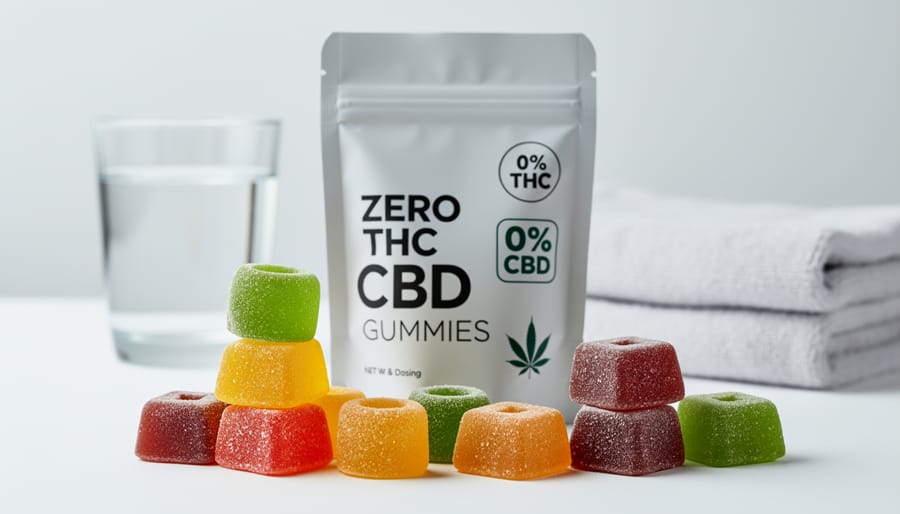
Gummies remain one of the most popular ways to take CBD, and zero THC options are widely available across Canada. What makes them particularly beginner-friendly? Pre-measured dosing takes the guesswork out of your routine. Most zero THC gummies contain between 10-25mg of CBD per piece, letting you start low and adjust gradually based on how you feel.
When shopping for best CBD gummies in Canada, look for products made with CBD isolate or broad spectrum CBD that’s been rigorously tested to confirm zero THC content. Many brands offer fruit-flavored varieties that make daily supplementation enjoyable rather than medicinal-tasting.
I appreciate gummies for their discretion and convenience, especially when traveling or at work. They’re shelf-stable, easy to portion, and don’t require any special equipment. The effects typically appear within 45-90 minutes since they’re processed through your digestive system, and can last 4-6 hours.
Dosing tip: Start with one gummy and wait at least two hours before considering another. Because edibles take longer to kick in than oils or vapes, patience prevents accidental overconsumption. Keep a simple journal noting your dose and effects to find your personal sweet spot.
Capsules and Softgels
If you’re someone who values consistency in your CBD routine, capsules and softgels might become your best friend. I remember when I first tried CBD capsules after months of guessing with oil droppers – it was honestly refreshing to know exactly how much I was taking every single time.
The beauty of capsules is their precision. Each one contains an exact amount of CBD, typically ranging from 10mg to 50mg, which takes the guesswork completely out of the equation. This is particularly helpful if you’re monitoring your dosage carefully or need to explain your routine to a healthcare provider.
For Canadians who travel frequently or have busy schedules, capsules offer unmatched convenience. They’re discreet, portable, and don’t require any measuring or preparation. Just pop one with water like any other supplement. Plus, there’s no taste to contend with, which matters if you’re not a fan of hemp’s natural earthiness.
Keep in mind that capsules take longer to kick in – usually 45 minutes to two hours – since they need to pass through your digestive system. However, many users find the effects last longer compared to other methods, making them ideal for sustained relief throughout the day.
Beverages and Drink Mix-Ins
If you prefer sipping your CBD throughout the day, THC-free beverages offer a gentle, enjoyable option. I’ve found that CBD-infused teas are particularly comforting in the evening – brands like Buddha Teas offer caffeine-free herbal blends with broad-spectrum CBD that’s been tested to confirm zero THC content.
For coffee lovers, water-soluble CBD powder mix-ins are increasingly popular. These formulations use nano-emulsion technology to help CBD blend seamlessly into hot or cold drinks without that oily separation you might see with regular CBD oil. Look for products specifically labeled as THC-free isolate or broad-spectrum with lab results confirming no detectable THC.
Ready-to-drink CBD beverages are also hitting Canadian shelves, from sparkling waters to functional wellness drinks. The advantage here is precise, consistent dosing – usually between 10-25mg per bottle. When shopping, always check that the product displays a clear “0% THC” or “THC-free” label and includes accessible third-party lab results. Since CBD beverages are relatively new to the Canadian market, availability can vary by province, so you might find more options through licensed online retailers.
What to Look for When Shopping for Zero THC CBD Edibles
Reading Labels and Certificates of Analysis
When I first started looking for zero THC products, I’ll admit I found product labels pretty intimidating. There were acronyms everywhere and numbers that didn’t mean much to me. But learning to read these labels properly became my superpower for finding truly THC-free CBD.
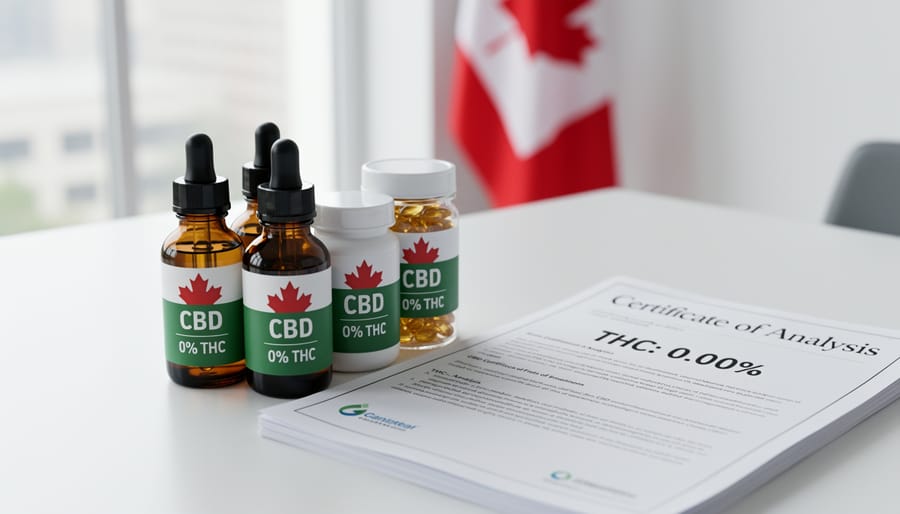
Every legitimate CBD product sold in Canada should have a detailed label listing cannabinoid content. Look for products that explicitly state “0% THC,” “THC-free,” or “undetectable THC levels.” Some labels might say “broad spectrum” or “CBD isolate,” which typically indicates THC has been removed, but you’ll want to verify this with additional documentation.
This is where Certificates of Analysis, or COAs, become essential. A COA is a lab report from an independent, third-party testing facility that breaks down exactly what’s in your product. Think of it as a report card that shows cannabinoid levels, potential contaminants, and confirms whether THC is truly absent.
To access a COA, check the product packaging for a QR code or batch number that links to test results. Reputable Canadian brands make these readily available on their websites. When reviewing a COA, look for the THC line – it should read “ND” (non-detect), “0.00%,” or fall below the testing facility’s detection limit, usually around 0.01%.
If a company doesn’t provide easy access to current COAs, that’s a red flag. In Canada’s regulated market, transparency isn’t optional. Don’t hesitate to contact customer service directly if you can’t locate testing documentation. Any trustworthy brand will happily provide this information.
Trusted Brands and Red Flags
When shopping for 0 THC CBD products in Canada, start by looking for third-party lab testing certificates, often called Certificates of Analysis (COAs). Reputable companies will make these readily available on their websites or product pages. These documents confirm that products contain no detectable THC and verify CBD content accuracy.
I learned this the hard way when I first started exploring CBD options. I purchased what claimed to be a THC-free product without checking for lab results, only to later discover the company couldn’t provide any testing documentation. Now I always verify before buying.
In Canada, trusted Canadian brands must comply with Health Canada regulations, which means products should have proper licensing information and clear labelling. Red flags include vague claims like “pure” or “natural” without supporting evidence, suspiciously low prices that seem too good to be true, and missing or incomplete ingredient lists.
Watch for brands that guarantee specific health outcomes, as this violates Canadian advertising regulations. Legitimate companies focus on quality and transparency rather than making exaggerated promises. When in doubt, check if the company provides accessible customer service and educational resources about their sourcing and testing processes.
Price Expectations and Quality Indicators
Quality zero THC CBD edibles in Canada typically range from $25 to $60 per package, depending on potency and brand reputation. While budget options under $20 exist, they often lack proper testing documentation or use lower-grade ingredients. I’ve learned that investing in quality CBD gummies from reputable brands means better consistency and peace of mind. Look for products with visible batch testing, clear CBD isolate sourcing, and transparent ingredient lists. Canadian producers who invest in rigorous third-party testing typically charge slightly more, but you’re paying for verified THC-free guarantees. Red flags include vague labeling, missing COAs, or prices that seem too good to be true. Remember, when it comes to zero THC products where accuracy matters most, cutting corners on cost can compromise the very purity you’re seeking.
Dosing Zero THC CBD Edibles: A Beginner’s Approach
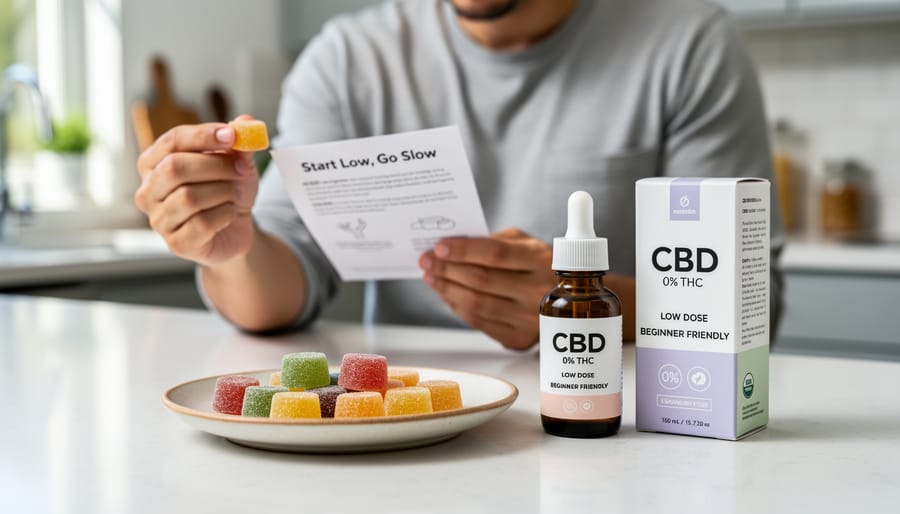
Starting Low and Going Slow
If you’re new to 0 THC CBD edibles, the golden rule is simple: start with a low dose and give it time to work. I usually recommend beginners begin with 5-10mg of CBD and wait at least two hours before considering more. I remember my first experience with CBD edibles—I was so eager to feel something that I nearly took a second dose after 45 minutes. Thankfully, I didn’t, because around the 90-minute mark, I finally noticed the calm, subtle effects I was hoping for.
Edibles work differently than oils or vaping because they need to pass through your digestive system first. This means the onset is slower, but the effects typically last longer—sometimes 4-6 hours. The waiting period can feel frustrating, especially when you’re dealing with discomfort or anxiety, but patience truly pays off here.
Since Canadian regulations allow you to easily track CBD content on product labels, use this to your advantage. Keep a simple journal noting your dose, timing, and how you felt. This helps you find your sweet spot without overshooting it. Remember, you can always take more next time, but you can’t take less once you’ve already consumed it.
When and How to Increase Your Dose
Finding the right CBD dose is personal, and what works initially might need adjusting as your body adapts. I’ve learned through my own experience that our endocannabinoid systems can change over time, and what felt effective at first may become less noticeable after a few weeks.
Signs you might need a higher dose include your original concerns returning, feeling like the effects wear off more quickly than before, or simply not experiencing the relief you initially had. However, it’s equally important to recognize that sometimes we just need to take a tolerance break rather than continuously increasing our intake.
If you decide to increase your dose, do it gradually. In Canada, where our CBD products are clearly labelled with exact milligram amounts, this is straightforward. Try adding just 5-10mg to your daily amount and maintain that for at least a week before assessing whether you need more. Keep a simple journal noting your dose, timing, and how you feel throughout the day.
Remember that more isn’t always better with CBD. There’s often a sweet spot, and going beyond it won’t necessarily improve results. If you find yourself needing significantly higher doses without effect, consult with a healthcare provider familiar with cannabinoid therapy. They can help determine whether CBD is still the right option or if something else is affecting your response.
The Legal Landscape: Zero THC CBD in Canada
Navigating the legal landscape for zero THC CBD in Canada can feel confusing at first, but I’m here to walk you through it. The good news? Canada has some of the clearest regulations around CBD products in the world.
Under federal cannabis law, CBD products (including edibles) are legal across Canada, but there’s an important catch when it comes to zero THC options. All cannabis products, including CBD edibles, must be purchased from licensed retailers—either provincial cannabis stores or authorized online platforms. You cannot legally buy CBD edibles from health food stores, pharmacies, or unlicensed websites, even if they claim to contain zero THC.
Here’s where it gets a bit tricky: truly zero THC CBD products are actually quite rare in Canada’s legal cannabis market. Most CBD products sold through licensed retailers contain trace amounts of THC (typically under 1mg per package or serving). This is because Health Canada’s regulations permit small amounts of THC in CBD products, and complete removal of THC is technically challenging and expensive.
If you absolutely need zero THC CBD, you’ll want to carefully check product labels and certificates of analysis. Some licensed producers do create THC-free isolate products, but availability varies by province. When I first started exploring this, I learned to always ask retailers specifically about lab testing results—reputable companies will have third-party test results confirming their THC content.
Each province has its own authorized retailers. In Ontario, for example, you’ll shop through the OCS or licensed brick-and-mortar stores. British Columbia residents use provincially licensed retailers, while Alberta has private retail options. Always verify that your source is licensed to ensure you’re getting safe, compliant products that actually contain what they claim.
Common Questions About Zero THC CBD Edibles
When I first started exploring THC-free CBD edibles, I had dozens of questions running through my mind. Over the years, I’ve heard similar concerns from friends and readers across Canada, so let’s tackle the most common ones.
Do zero THC CBD edibles actually work?
This is probably the question I hear most often. The short answer is yes, but they work differently than products containing THC. CBD interacts with your endocannabinoid system independently of THC, so you can still experience potential benefits like support for relaxation, discomfort management, and sleep quality. However, some people do find that products with a small amount of THC (even within the legal 0.3% limit) feel more effective due to what’s called the entourage effect. That said, I’ve personally found zero THC options quite helpful for my needs, and many Canadians report positive experiences.
Will zero THC CBD edibles make me feel high?
Absolutely not. THC is the only cannabinoid responsible for producing a psychoactive high. Without any THC present, you won’t experience any intoxicating effects whatsoever. You might feel more relaxed or calmer, but this isn’t the same as being high.
Where can I buy legitimate zero THC edibles in Canada?
You have several options. Licensed cannabis retailers sometimes carry CBD-dominant edibles with minimal or no THC. Health food stores and online retailers specializing in hemp-derived CBD products often have broader selections of zero THC options. Always look for third-party lab testing certificates, which verify the THC content. Reputable companies make these easily accessible on their websites or product packaging.
How long do they take to work?
Edibles typically take 30 minutes to 2 hours to take effect because they need to be digested first. Start with a low dose and be patient before taking more. I learned this the hard way early on by being too eager and doubling my dose too quickly.
Are they legal everywhere in Canada?
Hemp-derived CBD products containing zero THC exist in a somewhat grey area federally but are generally more accessible than cannabis-derived products. Cannabis-derived edibles are regulated provincially, so availability varies by location.
Finding the right zero THC CBD edible doesn’t have to feel overwhelming. Whether you’re navigating workplace drug testing, managing THC sensitivity, or simply prefer to avoid any psychoactive effects, there are quality options available across Canada that meet your needs. Remember to look for products with clear lab testing, appropriate certifications, and transparent ingredient lists. Start low with your dosage, give your body time to respond, and don’t hesitate to adjust as you learn what works best for you.
From my own experience exploring CBD products, I’ve learned that patience and research really do pay off. The Canadian market has come a long way in offering reliable, tested options that let you experience CBD’s potential benefits without any THC concerns. Trust the process, ask questions when you’re unsure, and know that you’re making an informed choice for your wellness journey.
You’ve got this. Armed with the right information and a clear understanding of what to look for, you can confidently explore zero THC CBD edibles and discover whether they’re the right fit for your lifestyle. Your CBD journey starts with that first informed decision.