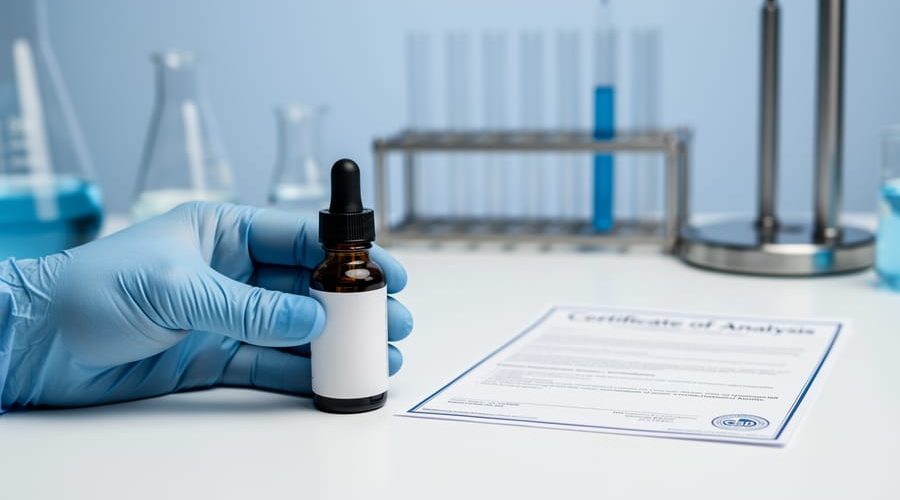
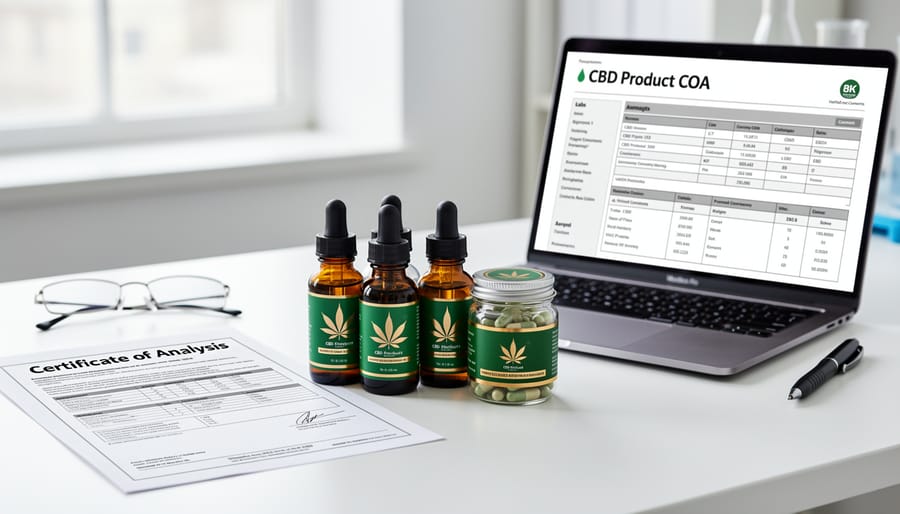
Request a Certificate of Analysis (COA) directly from any CBD brand before purchasing—legitimate companies provide these third-party lab reports within 24 hours, while evasive responses signal red flags. Check that the COA matches the specific product batch number on your bottle, not just a generic report the company recycles for multiple products. Verify the testing lab is independent and ISO-accredited by searching their name online; brands using in-house labs or unverifiable facilities often hide contamination issues.
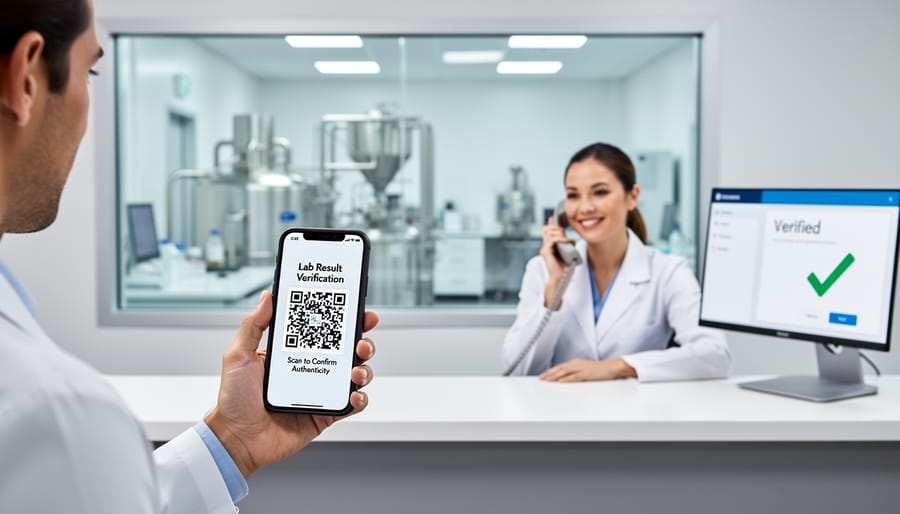
Look for comprehensive contaminant testing that includes heavy metals, pesticides, residual solvents, and microbial contaminants—not just cannabinoid potency. Many Canadian consumers discover their CBD contains lead, arsenic, or dangerous pesticide residues only after checking what COAs tell you about these hidden dangers. Download the COA as a PDF and contact the testing lab directly using contact information from their official website to confirm they actually tested that batch; fraudulent COAs circulate more commonly than most people realize.
When I started researching CBD safety for my own use, I assumed Health Canada’s regulations meant all products were automatically safe. That assumption nearly cost me—I found a popular brand’s COA showed fungus contamination at levels that could trigger serious health issues. The lab testing process seems intimidating at first, but learning to read these reports takes about fifteen minutes and protects you from products that could genuinely harm your health. This knowledge transforms you from a vulnerable consumer into an informed advocate for your own wellness.
Why Lab Testing Your CBD Actually Matters
What Can Hide in Untested CBD Products
Without proper lab testing, CBD products can harbour concerning contaminants that slip through the cracks. Understanding what might be lurking in untested products helps explain why those certificates of analysis matter so much.
Heavy metals like lead, arsenic, cadmium, and mercury frequently show up in contaminated CBD. These accumulate in hemp plants as they grow, since hemp naturally absorbs substances from soil—a characteristic that makes it great for environmental cleanup but potentially problematic for consumer products. Even small amounts can cause health issues over time, especially with regular use.
Pesticides and herbicides are another common concern. While Canada has strict regulations about pesticide use, not all producers follow these guidelines, and some imported products may contain chemicals banned here. These residues can trigger allergic reactions, hormone disruption, and other health complications.
Residual solvents from the extraction process present additional risks. Companies using hydrocarbon extraction methods sometimes leave behind traces of butane, propane, or hexane. Inhaling or ingesting these chemicals isn’t something you want in your wellness routine.
Microbial contamination—bacteria, mold, yeast, and fungi—can develop during cultivation, processing, or storage. This becomes particularly dangerous for people with compromised immune systems.
I learned about these risks the hard way early in my CBD journey. After experiencing unexpected side effects from a bargain-bin product, I discovered it had never been tested. That experience taught me that saving a few dollars isn’t worth compromising my health. Now I won’t touch a CBD product without verifying its lab results first.
The Canadian CBD Testing Landscape
Canada’s CBD testing landscape is a tale of two markets. If you’re buying from a licensed producer through legal cannabis retailers, you’re getting products that have undergone mandatory Health Canada testing. These producers must test for potency, pesticides, heavy metals, microbial contaminants, and residual solvents before their products hit shelves. It’s reassuring protection that genuinely matters for safety.
However, many Canadians purchase CBD from the grey market—health food stores, online retailers, or wellness shops selling products derived from industrial hemp. Here’s where things get murky. These products technically fall into a legal grey zone, and there’s no mandatory third-party testing requirement. Some companies voluntarily provide Certificates of Analysis, while others don’t test at all.
I learned this distinction the hard way when a friend showed me a CBD oil she’d bought from a local health shop. No COA, no batch number, just marketing claims about purity. When we contacted the company, they couldn’t provide any testing documentation. It’s a stark reminder that legal protections have significant gaps.
The reality? Licensed cannabis stores offer the strongest consumer protections, but limited product variety and higher prices drive many toward grey market options. If you’re shopping outside the legal cannabis system, verifying lab testing becomes entirely your responsibility. Understanding this landscape helps you make informed decisions about where to spend your money and which products genuinely prioritize your safety.
Decoding Your Certificate of Analysis (COA)
The Essential Elements Every COA Should Have
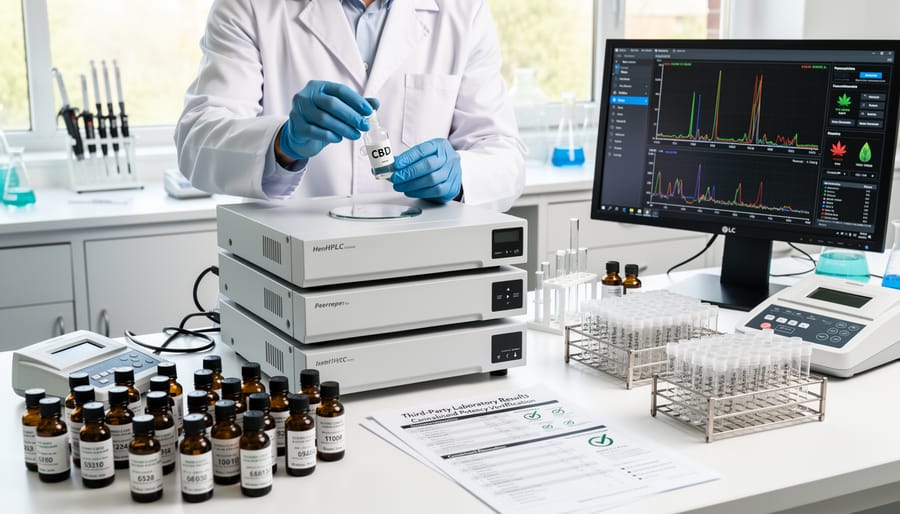
When I first started reviewing CBD products, I was overwhelmed by all the information packed into lab reports. But over time, I realized that every legitimate Certificate of Analysis should include several non-negotiable elements. Think of this as your quality checklist.
First, look for clear lab accreditation information. The testing facility should hold ISO/IEC 17025 accreditation, which is the gold standard for testing laboratories. This ensures the lab follows strict quality control protocols and their results are reliable. If you can’t find accreditation details, that’s a red flag.
Next, check for batch or lot numbers that match your product’s packaging. This confirms you’re viewing the correct report for what you purchased. I’ve caught mismatches before, and it’s concerning when companies can’t provide matching documentation.
Test dates matter more than you might think. Results should be relatively recent, ideally within the past year. Older reports don’t account for degradation over time, which is why CBD shelf-life testing exists.
The cannabinoid profile section should list CBD, THC, and other cannabinoids with precise percentages. In Canada, remember that THC must stay under 0.3 percent for legal hemp-derived products.
Finally, comprehensive contaminant panels are essential. Look for testing results covering heavy metals like lead and mercury, pesticides, residual solvents from extraction, microbial contaminants including mold and bacteria, and mycotoxins. Each category protects you from specific health risks. Missing even one panel means incomplete safety verification, and you deserve complete transparency when choosing products for your wellness routine.
Understanding Cannabinoid Potency Results
When you first look at a Certificate of Analysis, the cannabinoid potency panel might seem like alphabet soup. Let me help you decode what those numbers actually mean.
Cannabinoid results appear in two formats: percentages (%) and milligrams per gram (mg/g). Here’s the simple truth—they’re the same thing. A product showing 10% CBD contains 10 mg of CBD per gram of product, or 1,000 mg per 100g bottle. I remember staring at my first COA wondering why labs used both measurements. Turns out, it’s just different ways of expressing the same data.
The most important cannabinoids you’ll see listed are CBD (cannabidiol), THC (tetrahydrocannabinol), CBG (cannabigerol), and CBN (cannabinol). CBD is your primary therapeutic compound, while THC is the psychoactive component that must stay below legal limits in Canada.
Speaking of legal limits, this is crucial: Canadian regulations require hemp-derived CBD products to contain no more than 0.3% THC. Always check this number carefully on any COA. If a product shows THC levels above 0.3%, it’s not legally compliant for sale as a hemp product in Canada. I’ve seen products marketed as “legal CBD” that actually exceeded this threshold—one reason why verifying lab results yourself matters so much.
You’ll also notice terms like “Total CBD” versus “CBD.” Total CBD includes both the active CBD and CBDA (the acidic precursor), giving you the complete picture of cannabinoid content after potential decarboxylation through heating or time.
Making Sense of Contaminant Testing Panels
When I first started checking lab reports, I remember seeing “ND” next to dozens of contaminants and wondering if that was actually good news. Turns out, ND means “not detected,” which is exactly what you want to see. Let me walk you through what these contaminant panels actually test for and why they matter.
Heavy metals testing looks for arsenic, cadmium, lead, and mercury—all of which can accumulate in hemp plants from soil or water. Health Canada hasn’t published specific limits for CBD products yet, but reputable labs typically follow limits established for cannabis (under 10 parts per million for most metals). You’ll usually see results listed in PPM or PPB (parts per million or billion). The lower, the better, with ND being ideal.
Pesticide panels can test for anywhere from 60 to over 200 different chemicals. This is particularly important because hemp is sometimes marketed as a “bioaccumulator,” meaning it absorbs whatever’s in the soil—including pesticides from previous crops. Canadian regulations prohibit the use of most pesticides in cannabis cultivation, so any detectable levels should raise concerns. Labs will typically show either ND or specific concentrations, with a clear pass or fail designation.
Residual solvent testing applies mainly to extracts and concentrates. If a company uses ethanol, butane, or CO2 extraction, traces of these solvents can remain in the final product. Acceptable limits vary, but you’re looking for readings well below 5000 PPM for most solvents, with some requiring much stricter limits.
Microbial contaminants include E. coli, salmonella, and total yeast and mold counts. These tests should show absence or very low colony counts. Finally, mycotoxin testing looks for toxic compounds produced by mold, particularly aflatoxins and ochratoxins. Any detection here is problematic—you want to see ND across the board.
When a COA says “pass,” it means the product met the lab’s established safety thresholds for that contaminant category. But here’s the thing: not all labs use the same thresholds, which is why seeing the actual numbers matters more than just a checkmark.
How to Verify a COA Is Legitimate (Not Fake)
Red Flags That Scream ‘Don’t Trust This COA’
I’ve learned to spot problematic COAs from across the room now, and I want to help you develop that same radar. Here are the red flags that should make you think twice before purchasing.
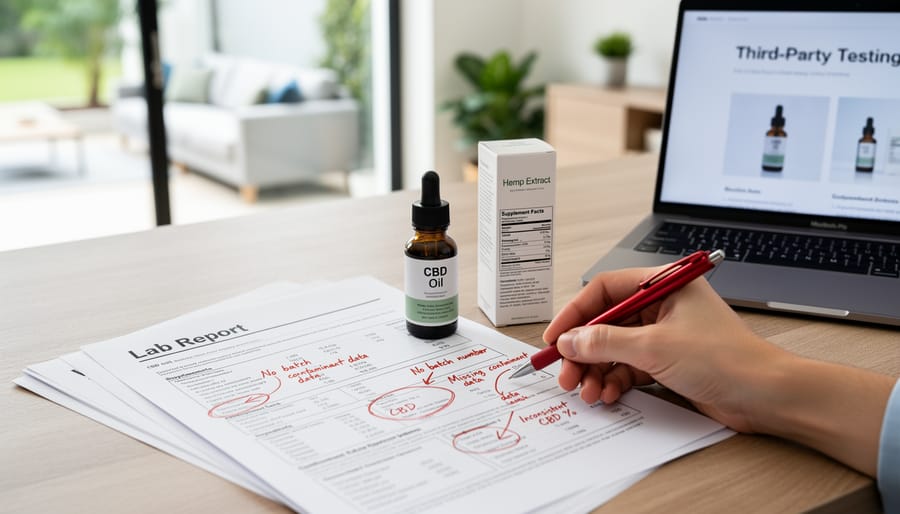
Missing or vague batch numbers are a major warning sign. Every legitimate COA should have a specific batch or lot number that matches the one printed on your product label. If you see generic dates or no batch identifier at all, that company could be recycling the same COA across multiple products—a practice that’s unfortunately more common than it should be.
Test dates are another critical element. I once reviewed a product where the COA was nearly two years old. Since test dates matter for product integrity, using outdated results suggests the company isn’t regularly testing their products or, worse, had poor results on newer batches and chose to hide them.
Incomplete testing panels should immediately raise concerns. A trustworthy COA tests for cannabinoid potency, heavy metals, pesticides, residual solvents, microbial contaminants, and mycotoxins at minimum. If you’re seeing only cannabinoid results, ask yourself what they’re not showing you.
Watch out for non-accredited or unverifiable labs. The testing facility should be ISO 17025 accredited, and you should be able to verify this independently. I’ve seen COAs from labs that don’t even have working websites or contact information.
Finally, suspiciously perfect results are actually a red flag. If every single cannabinoid value is a round number or the product shows absolutely zero contaminants across every category, it might be fabricated. Real lab results typically show some variation and trace amounts of various compounds. Trust your instincts—if something looks too good to be true, investigate further.
Trusted Third-Party Labs in Canada
When I first started researching CBD products in Canada, I quickly learned that not all lab testing is created equal. The gold standard you should look for is ISO/IEC 17025 accreditation, which demonstrates that a laboratory meets internationally recognized standards for competence and quality management.
Several reputable third-party labs serve the Canadian CBD industry. Facilities like ProVerde Laboratories in Massachusetts (which tests for many Canadian companies), and Canadian operations like Kaycha Labs and MB Labs have earned recognition for their thorough testing protocols. These labs must maintain strict ISO 17025 accreditation and often work closely with Health Canada’s licensing requirements.
When evaluating a lab’s credibility, check for current ISO 17025 certification on their website. This accreditation means the lab undergoes regular audits and maintains validated testing methods. Additionally, labs testing cannabis products for federally licensed producers must comply with Health Canada’s cannabis testing regulations, which set minimum standards for accuracy and reliability.
Some CBD companies use labs with additional certifications like Good Laboratory Practice (GLP) or are registered with organizations such as the Hemp Authority. While these aren’t mandatory, they indicate extra commitment to quality control.
Here’s a practical tip: legitimate third-party labs always display their accreditation certificates publicly and include their contact information on Certificates of Analysis. If you’re ever unsure about a lab’s credentials, you can verify their ISO 17025 status through the Canadian Association for Laboratory Accreditation (CALA) or contact the lab directly to request proof of current certification.
What to Do When a Brand Won’t Share Lab Results
If a brand refuses to share their Certificate of Analysis or seems evasive when you ask, that’s a significant red flag. Here’s how to handle it professionally while protecting yourself.
Start with a simple, direct inquiry through their website contact form or customer service email. Ask something like: “Hi, I’m interested in your CBD oil. Can you share the most recent third-party lab results for this product?” A legitimate company should respond within a few business days with either a link to their COAs or an attached PDF.
Reasonable responses include directing you to a page on their website where all lab results are posted, emailing you the specific COA, or explaining that results for a new batch will be available soon (with an actual date). Some smaller Canadian companies might take slightly longer to respond than large brands, but they should still be willing and able to provide this information.
Warning signs include vague answers like “our products are tested and safe” without providing actual documentation, claiming their results are proprietary or confidential, or insisting you make a purchase before seeing lab results. These responses suggest the company either hasn’t actually tested their products or has something to hide.
I once contacted a brand that kept deflecting my COA requests with marketing speak about their “rigorous quality standards.” After three attempts, I walked away. It felt frustrating, but a few months later, that company faced recalls for contaminated products. My gut instinct was right.
If you don’t receive lab results after two follow-up attempts, or if the company becomes defensive, move on. There are plenty of transparent Canadian CBD brands who readily share their testing data. Your safety isn’t worth compromising for any product, no matter how appealing the marketing might be.
My Personal COA Verification Checklist
Over the years, I’ve developed a pretty reliable routine for checking COAs before I buy any CBD product. It might seem like a lot at first, but honestly, once you do it a few times, it becomes second nature—and it only takes about five minutes.
First thing I do is check whether the COA even exists. I won’t consider a product without one, period. I look for it on the company’s website, usually in the product description or a dedicated lab results section. If I can’t find it easily, that’s already a red flag for me.
Once I’ve got the COA in front of me, I verify it’s from a third-party lab, not the brand’s own facility. I look for the lab’s name at the top of the document and sometimes do a quick search to confirm they’re an actual independent testing facility. I’ve caught a few sketchy situations this way.
Next, I match the batch number. This is crucial—the batch number on the COA needs to match what’s printed on the product packaging. I learned this the hard way when I realized a company was using the same generic COA for multiple products. Different batches can have completely different cannabinoid profiles and contamination levels.
Then I scan for the cannabinoid content. I check that the CBD percentage matches what’s advertised on the label, and I make sure THC levels are within Canadian legal limits—that means staying well under the legal threshold to avoid any issues.
The contamination section is where I spend most of my time. I look for test results covering pesticides, heavy metals, residual solvents, and microbial contaminants. Everything should show as “passed” or display levels below the acceptable limits. If any section is missing or shows “not tested,” I move on to another product.
Finally, I check the test date. The COA should be relatively recent—I prefer results from within the last six months to a year. Older results might not reflect the current product quality.
This checklist has saved me from purchasing questionable products more times than I can count, and it gives me real peace of mind knowing exactly what I’m putting in my body.
I know all of this—COAs, third-party testing, heavy metals, pesticides—can feel overwhelming at first. When I started researching CBD products for myself, I remember staring at a certificate of analysis and thinking it looked like something only a chemist could understand. But here’s what I’ve learned: you don’t need a science degree to protect yourself. You just need to know what to look for, and now you do.
Start small. Choose one trusted brand that checks all the boxes we’ve discussed: third-party testing, accessible COAs, transparent about their testing labs, and compliant with Canadian regulations. Use their products, get comfortable reading their lab reports, and build your confidence from there. You’ll be surprised how quickly it becomes second nature.
Yes, it takes a bit more time upfront to verify lab testing and authenticate certificates. But your health and safety are worth those extra few minutes. The CBD market in Canada is still evolving, and while Health Canada provides regulatory oversight, you remain your own best advocate.
Remember, convenience should never trump safety. If a brand makes it difficult to access lab results or seems evasive about their testing practices, that’s your cue to walk away. There are plenty of reputable companies that will gladly share their testing data because they’re proud of their quality standards.
You’ve got the knowledge now. Trust yourself to use it, and don’t hesitate to ask questions when something doesn’t seem right.